
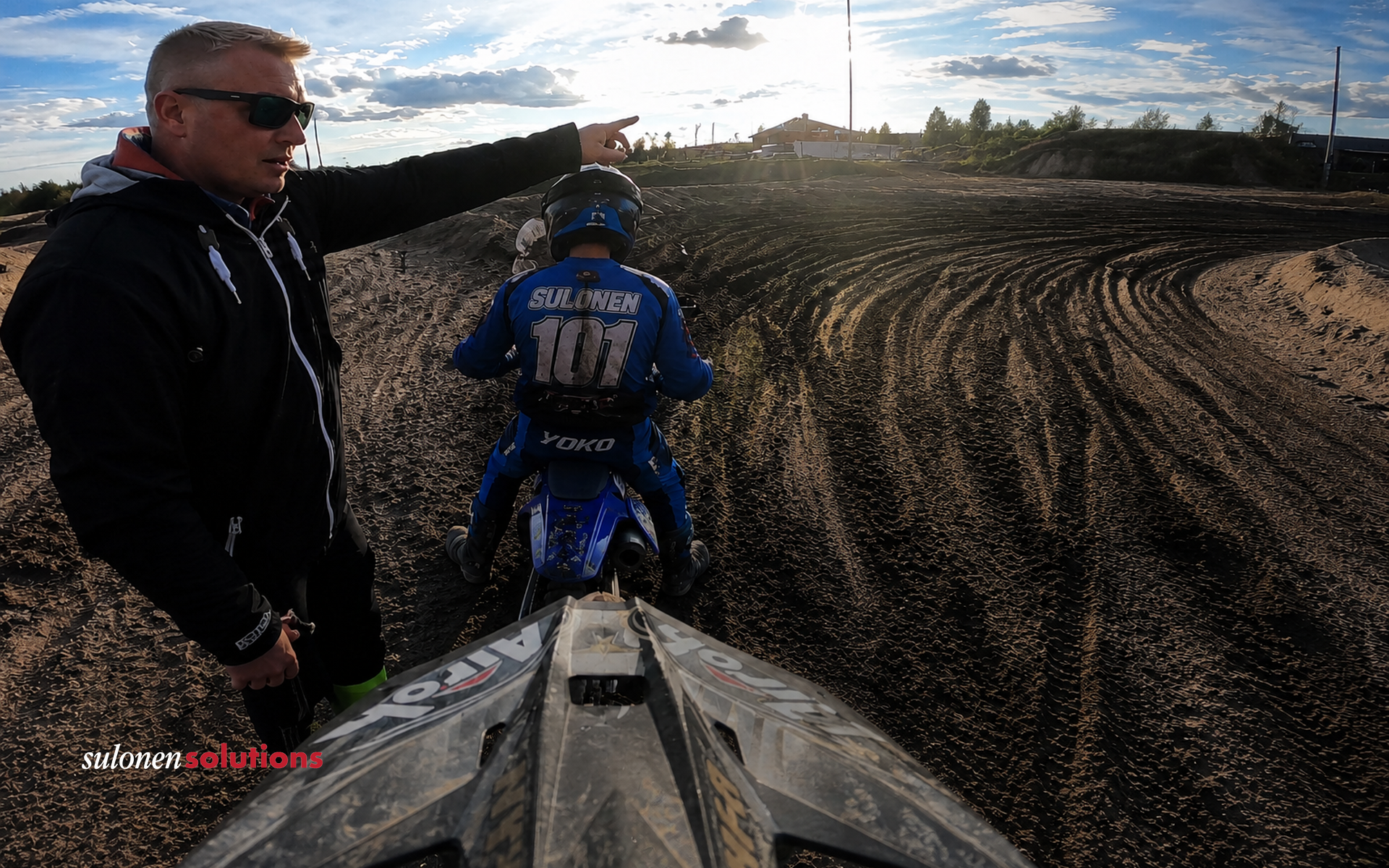
In motocross, staring at the front wheel makes the rider crash. In leadership, the same thing happens a little more slowly – and usually at a much higher cost.
A young motocross rider approaches a corner. The track is full of ruts, bumps and loose stones. The bike moves beneath them, and the first natural reaction is to look down.
Their gaze drops to a metre in front of the bike. Sometimes almost as close as their own front fender.
Then the ride starts to become unstable.
The bike wobbles towards the inside of the corner, balance falls apart and the riding line begins to wander uncontrollably. The rider tries to manage every stone, hole and movement of the front wheel separately. The more they try to correct the situation, the more unsettled the riding becomes.
To a beginner, the solution sounds almost absurd:
Stop staring at the front wheel. Lift your eyes and look where you are going.
The front wheel will follow
I led the junior division at Vantaa Motor Club and coached young riders at our motocross school. When teaching cornering, I often repeated the same instruction.
I might stand beside the track 20–30 metres beyond the corner and shout:
– I don’t want to see the peak of your helmet. I want to see your goggles – all the time!
– Look at me as you enter the corner. Look at me as you come out of it!
– The front wheel will stay attached to the bike even when you aren’t staring at it constantly!
When the rider dared to lift their eyes from the front fender and lock their gaze on the exit of the corner, something surprising happened.
The ride became stable.
The wobbling decreased, the bike stayed on its line and accelerating out of the corner became calmer. The rider was already able to prepare for the next straight and the next jump instead of still fighting with the hole the front wheel had crossed a second earlier.
The best moments were the realisations after the corner:
– Hey Ville, did you see that? That went really well! I was going really fast, and I didn’t wobble at all!
Yes I did. Now it went very well!
You ride where you look.
Focus is more than concentration
By focus, I mean consciously directing your attention towards something or a particular goal. It is not simply the ability to finish one task without being distracted by a phone beeping beside you.
Focus is a framework that guides action.
It determines what we consider important, where we spend our time and what we begin to notice around us. That is why focus shapes the outcome in sport, business and life in general.
Where are we looking?
What are we searching for?
What are we reinforcing with our attention?
And above all: are we looking where we are going – or are we still staring at the stone we have already ridden over?
A leader’s vision must reach the furthest
The same principle applies in business.
First, the direction and destination are decided. They may be defined by the strategy, budget, sales targets and most important KPIs.
Then everyone keeps their eyes in that direction.
This does not mean that problems should be ignored or mistakes left uncorrected. In motocross, you do not close your eyes to the holes in the track either. You take them into account, but you do not make them the purpose of the entire journey.
A leader’s job is to see beyond the individual hole.
The higher you operate within an organisation, the further ahead your vision should reach. Someone in the management team must be able to see the next corner. The CEO should already be able to see the straight beyond it.
At its purest, leadership is exactly this:
There must be someone in the group whose vision reaches furthest towards the goal.
Someone who ensures that the shared direction remains clear even when everyone else’s attention inevitably drops to the problems of the day, individual customer complaints and operational details.
When a leader starts staring at the front fender
Leadership begins to wobble the moment irrelevant details become more important than the direction.
Imagine a leader spending their time investigating why one employee’s phone bill was 52 € last month while another employee’s was 48 €.
The issue may technically be real. Perhaps a four-euro difference can be identified. A meeting can be arranged, an explanation requested and a new approval procedure created.
Meanwhile, the market is changing, an important customer is considering a competitor and the next jump that matters to the business is rapidly approaching.
But the leader’s attention is still fixed on those four euros.
The front wheel passed over the stone a long time ago. Staring at it will no longer change the direction of the bike. It will only ensure that the rider fails to notice the next hole.
This is not precision.
It is a loss of focus disguised as precision.
Leading through the rear-view mirror is even more dangerous
Another dangerous habit is focusing almost entirely on what has already happened.
Why did last year’s result fall short of the target?
Who made the mistake?
Why did we do things differently before?
Who approved the decision three years ago?
The past should be examined when it can teach us something that will help us in the future. But the past should not be confused with the destination.
Imagine riding a motocross bike down the main straight at full speed while constantly looking backwards.
I have not tried it. And I do not intend to.
There are easier ways to end up in hospital.
Yet this is exactly how organisations are led. Meetings fill up with explanations, old failures and stories about how things used to be. Everyone is staring so intently into the rear-view mirror that no one can see where the road ahead is turning.
Learn the lesson from history.
Then lift your eyes and look ahead again.
What you focus on grows
There is an old saying:
What you focus on grows.
In leadership, this becomes very tangible.
When a leader constantly focuses on past mistakes, possible failures and everything that must not happen, the organisation begins to do the same.
The workplace learns to avoid mistakes instead of pursuing success.
Decisions are no longer based on what would move the company forward, but on what is least likely to leave someone accountable later.
People spend their energy protecting themselves, preparing explanations and justifying decisions that have already been made. Eventually, most of the organisation’s resources are devoted to nurturing the very outcome it wanted to avoid.
The organisation no longer has a clear direction in which it wants to go.
It only has a long list of places where it does not want to end up.
That is a crucial difference.
Focus does not remove problems – it puts them into perspective
Good focus does not mean pretending to be positive or sweeping problems under the carpet.
It means addressing problems in relation to the goal.
If a mistake prevents us from reaching the destination, we correct it.
If a process slows the operation down, we improve it.
If an indicator points in the wrong direction, we respond.
But not every stone needs to be placed on the conference-room table for examination. Not every deviation is a strategic crisis, and not every four-euro difference deserves the attention of the management team.
A leader’s most limited resource may not be money.
It is attention.
Where a leader directs their attention, the organisation’s time, conversations and energy will soon follow.
That is why choosing where to focus is always a leadership decision.
Where are you looking?
Look down, and you will start seeing nothing but holes.
Look back, and you will see only what has already happened.
Look ahead, and you can still influence what happens next.
A leader does not need to know the exact location of every stone on the track. But they do need to know which direction the organisation is heading, where the next corner is and which jump the entire organisation should be preparing for.
What you focus on grows.
What kind of leader do you work with?
And an even more important question:
Where is your own attention fixed right now?