A month ago, I was genuinely excited about this. I took a photo of a pH meter with my phone, gave the image to ChatGPT and asked: “How do I use this?” The AI identified the device, explained the buttons and showed me how to use it. Pretty impressive, right? At the time, I wrote about it as an example of how far the practical use of AI had already come.
Now, about a month later, it already feels old-fashioned.
Not because image recognition or creating instructions for using a device has become useless. But because I have already moved three steps beyond that myself. First, I asked AI for advice and did the work myself. Next, I asked AI to build a complete program for me. Now I give it the entire task.
And this is where things become genuinely interesting.
My living room currently contains a small hi-fi studio
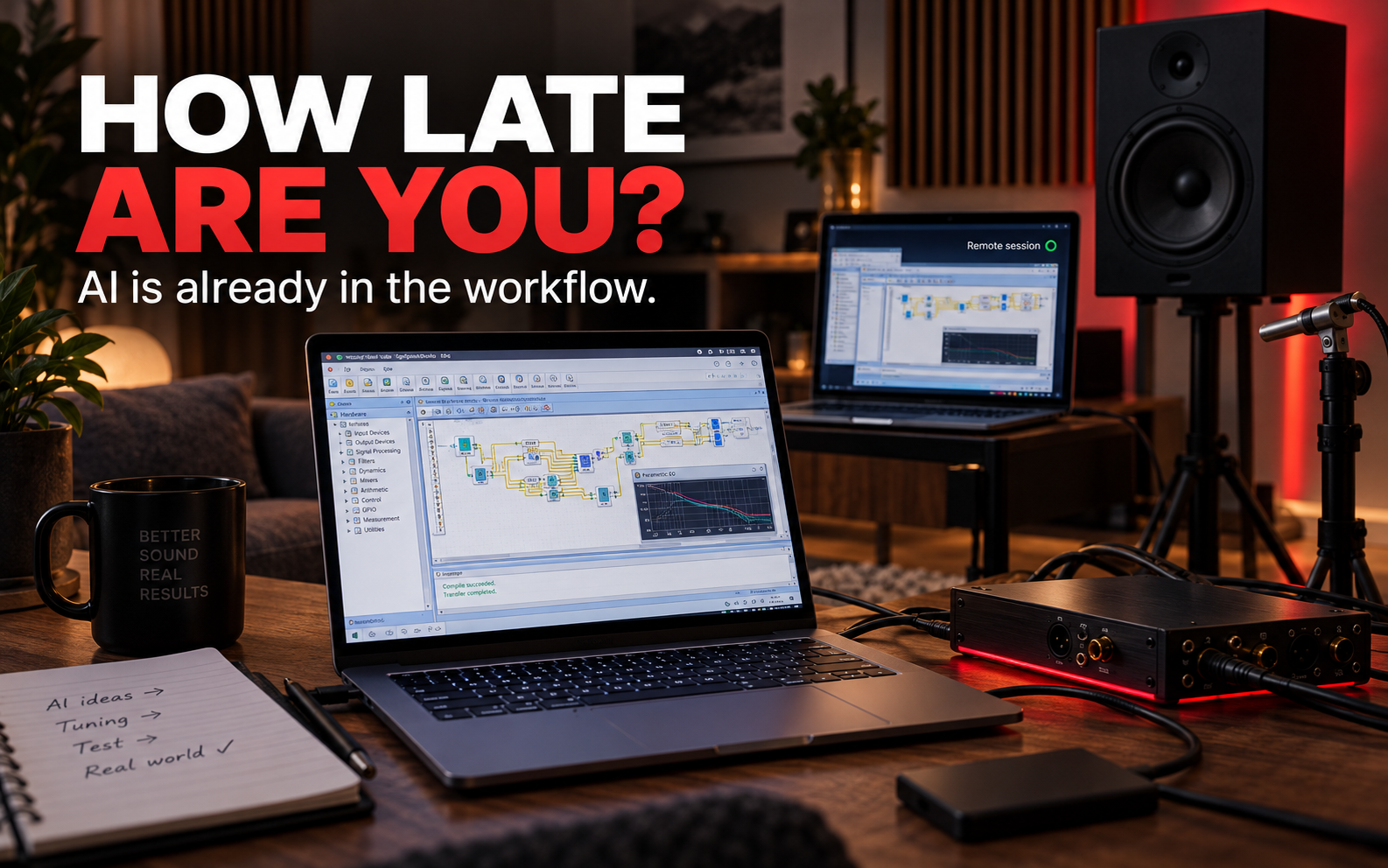
I build hi-fi equipment in my spare time, and right now I am working on a pair of three-way active dipole speakers. A speaker is standing in the middle of the living room, surrounded by a measurement microphone, amplifiers, cables and a DSP box that handles the crossovers, delays, corrections and other signal processing between the drivers. The DSP is programmed with SigmaStudio.
There is just one small practical problem. I use a Mac, but SigmaStudio only runs on Windows. I solved this by digging out an old Intel MacBook Air, installing Windows on it and physically connecting it to the DSP hardware. My new Mac, in turn, controls that Windows machine lying on the floor through a remote connection.
Up to this point, this is still perfectly normal geeky hobby stuff.
Then ChatGPT Work and Codex entered the picture.
Three steps in just a few months
The first way I used AI was the familiar one: I asked, it answered, and I did the work. If something did not work, I took a photo, asked again and tried the next option. Even this accelerated the work enormously.
At the next stage, I asked myself a fairly simple question: why should I ask AI to tell me how to build the program? Why not ask it to build the program? I define the architecture, crossover frequencies, filters, PEQs, gains and the other functionality I want. The AI builds the whole thing and gives me a finished program.
For a while, even that felt quite advanced.
Then I realised that even there, I was still an unnecessary middleman.
Give it the objective. Not the task step.
This is the point where my own understanding of AI changed the most.
Work no longer just sits somewhere in the cloud telling me what I should do. It can work on my computer. That alone is a huge leap: AI no longer merely advises a human on how to use a computer. It can physically perform the actual work on the computer itself.
But in my case, the chain goes even further. Work operates on my Mac and uses the remote connection built into it to control another computer lying on my living-room floor. On the Windows machine, it uses SigmaStudio, builds the DSP program, makes changes and tests them. And the chain does not even end at that computer: at the other end of a USB cable sits a physical DSP box.
In practice, Codex is already inside my stereo system.
It builds the program, loads it onto the DSP, reads any errors, fixes them, writes a new version and tests again. I can sit beside it and watch the screen change as the work progresses.
AI is no longer, for me, a black box running somewhere in the cloud that I type questions to in a browser text field. It is on my Mac. It uses the Windows computer on my floor. It communicates with SigmaStudio. And at the end of the chain, it programs physical electronics through which my living-room speakers operate.
AI is no longer only online. It has entered the living room.
And to me, this is a far bigger change than a new chatbot version or a slightly better text generator.
At the same time, companies are still wondering whether they should try ChatGPT
My rough estimate is that around 80% of business decision-makers still have not properly understood what has happened during the past year. And an even smaller share understand how dramatically the pace of development has accelerated in just the last few months.
In the business world, people are still discussing whether documents may be given to ChatGPT. Should employees receive prompt training? Could it perhaps help write emails a little faster? Should we now create an AI policy and establish a working group to investigate the matter?
Meanwhile, I am sitting in my living room on a Sunday watching AI use two computers, build software, communicate with a physical DSP device and take the entire task towards a finished result.
That is quite a gap.
Dinosaurs in the business world have one defining characteristic: they call slowness deliberation.
And if someone is offended by the word dinosaur, I think that is beside the point in this discussion. Technology is not going to slow down while everyone waits to feel comfortable.
“Let’s wait six months” may not mean six months
At least to my eyes, AI development does not currently look linear. New capabilities are built on top of previous ones, combined with each other, and suddenly something that felt advanced a month ago looks primitive today.
A month ago, I took a photo of a device and asked AI how to use it.
Now I give AI the objective, and it goes to the device itself.
If development continues in the same direction, “let’s wait a few more months” does not necessarily mean that you are only a few months behind. In terms of working methods, the gap can grow into years during that time. That is why I sometimes deliberately exaggerate by saying that some companies are already a couple of years late — and soon it will be ten.
Not on the calendar.
In capability.
This is not really an article about DSP
The DSP just happened to be the test subject this time.
The much more interesting question is what this means for companies. For a long time, we have asked: “How could AI help with this task step?” I think that question is already too small.
A better question is: “Why is a human still doing this task step at all?”
And then comes an even more interesting question:
Why give AI a task step when we can give it the objective?
At that point, we are no longer talking about using ChatGPT. We are talking about processes, organisations, leadership, productivity and competitiveness. We are talking about which parts of the work should be done by people and which can be assigned to a system capable of planning, executing, reviewing and correcting its own work.
This is what I believe companies should be discussing right now. Not next year. Not when AI is “ready”.
It will never be ready.
Tomorrow, it will be able to do more again.
The future is not coming. Right now, it is running on a Windows computer on my living-room floor.
And soon, even that will already be old-fashioned.
When a company considers whether it needs more management capacity, the first thought is almost always the same: do we need to hire someone? Post a job advertisement, conduct interviews, perhaps bring in a headhunter, and hopefully, a few months later, the right person will be sitting across the table.
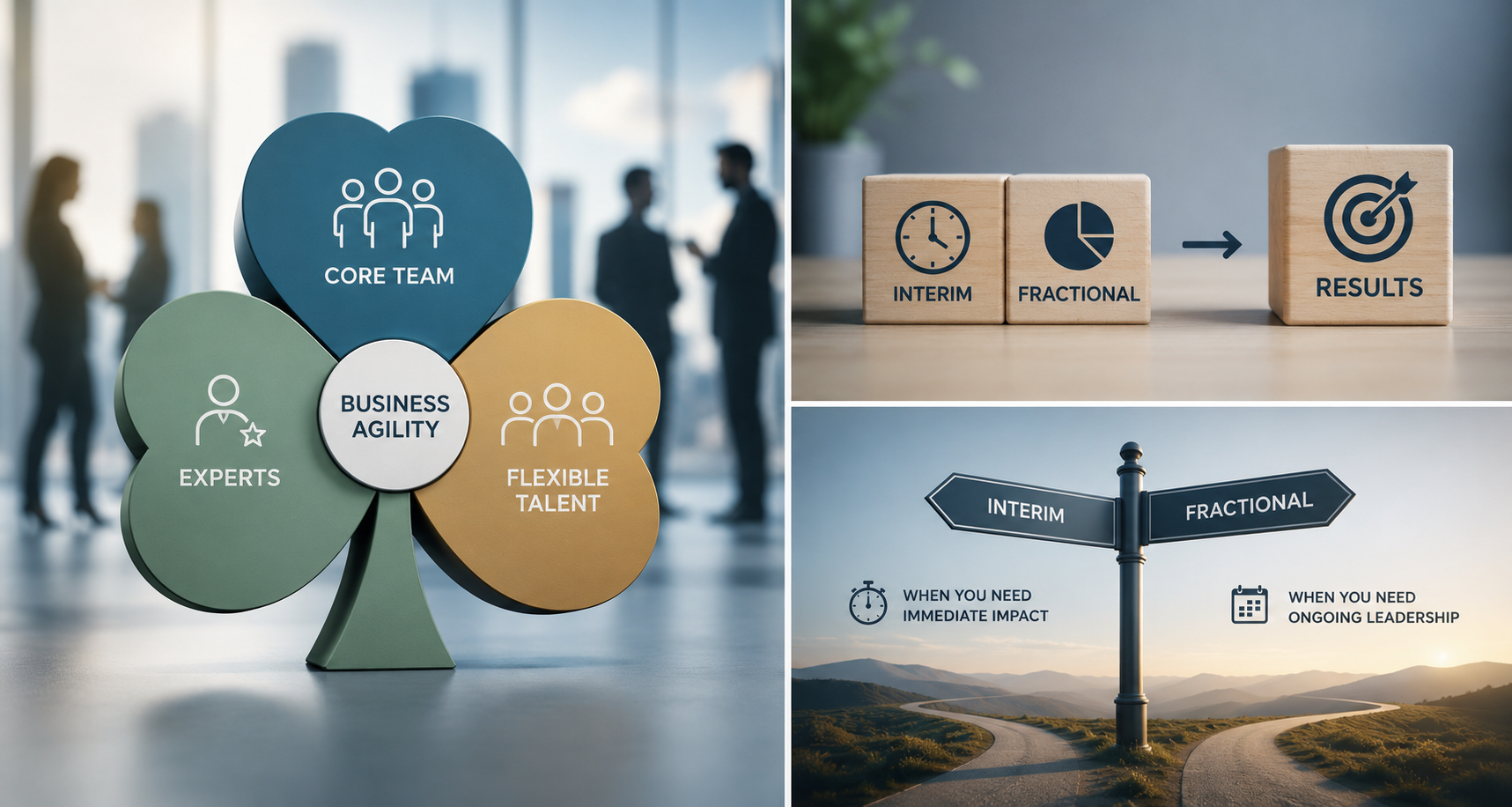
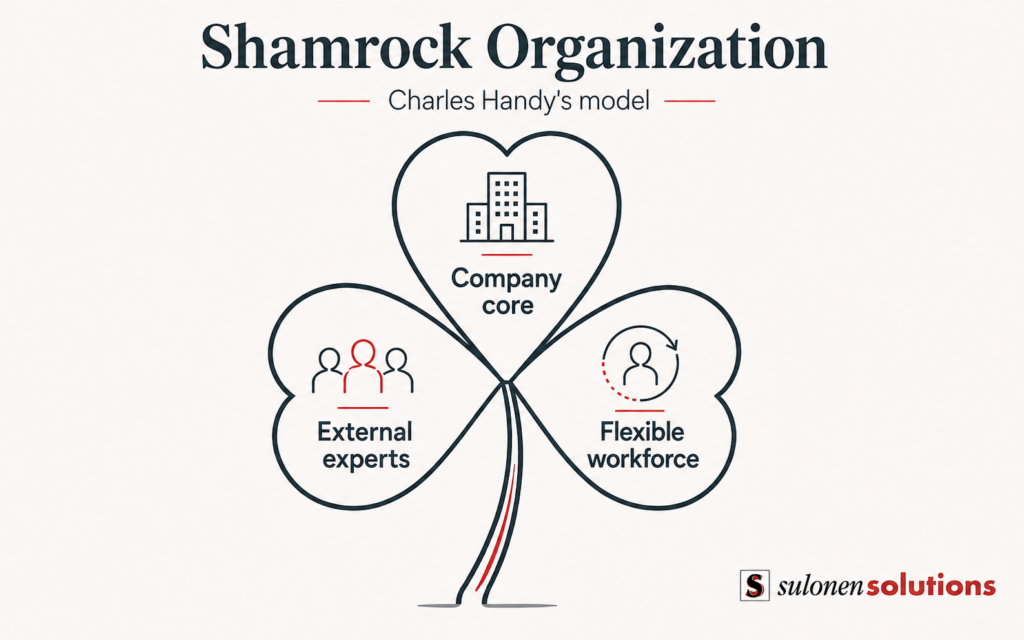
That is a perfectly valid way to solve the problem – when the need is permanent. But not all needs are permanent, and this is where it is worth borrowing from British management thinker Charles Handy and his “shamrock organisation”. Handy’s idea was simple: a company has a small, permanent core that is responsible for direction, values and continuity – and around this core is a range of other, more flexible resources that are brought in precisely when they are needed. (Read my other article on the topic.)
This article focuses specifically on that more flexible layer: Interim and Fractional management, from the perspective of the company buying the service.
Interim and Fractional do not compete with permanent employment
Let’s start with something that is not discussed enough: Interim and Fractional are not alternatives to permanent employees when permanent employees are the right solution. They are alternatives for situations where permanent employment is not the most efficient model.
So where does permanent employment work best? As the name suggests – in permanent situations. A company needs a permanent, stable team at its core to carry its long-term direction, approach and values. Many roles in a company also specifically require continuous presence and predictability, and that is precisely what a permanent, stable workforce provides.
But that is more or less where the need for stability ends. Today’s business environment is not particularly stable, and the future does not look any more promising in that regard. Markets change, technology – and now artificial intelligence in particular – is reshaping industries faster than organisational charts can be updated, and geopolitical developments can turn the entire operating environment upside down at short notice.
The only constant is continuous change.
In this world, companies’ expertise needs are no longer as often permanent as they once were – and that is entirely natural, not a problem that must be forced into the mould of permanent recruitment.
Interim and Fractional respond to a need – for change and development
Both models share the same core promise: a company can quickly access the expertise and work contribution it needs without having to commit to the obligations and risks of a long-term employment relationship.
Recruitment always involves risk. The impression created in an interview and the reality of day-to-day work do not always match – competence, motivation and effectiveness may turn out to be quite different from what the CV and interview promised. On top of this come sick leave, statutory annual leave and holiday pay, as well as the employee’s entirely justified expectations of the employer. In other words: the employer’s obligations towards the employee, some of which are precisely what many managers privately call “dealing with the HR merry-go-round” – not because employees are a problem, but because managing it takes time and attention away from the actual business.
Under the Interim and Fractional models, a company can transfer a significant part of this burden to the service provider – particularly recruitment risk, employer obligations and the risk of long-term commitment. This is closer to a planned B2B transaction than an employment relationship: the service provider sells an agreed service package to the client company, takes responsibility for any absences and for managing their own time, and invoices according to the agreed model – on a daily, monthly or project basis, depending on the situation.
When are Interim and Fractional services the right choice?
Interim management is the better known of the two, so let’s start there. The most typical Interim assignments involve serving as a CEO or CFO. What these situations have in common is the sudden but temporary emergence of a need: the dismissal or resignation of a CEO, their move to a competitor, a prolonged illness, a death or some other unexpected situation. There may also be a need for a rapid, radical change in the company’s direction or strategy – or simply a financial situation in which an unprofitable company or an overly heavy organisation must quickly be restored to a sustainable footing. Often, the previous CEO has already been relieved of their duties and the company needs an experienced, proven change leader who brings a different way of thinking and operating.
Whatever the situation, an Interim manager usually brings the following benefits:
Rapid start – often within a few weeks, compared with recruiting a permanent CEO and accounting for notice periods (easily +/- 6 months)
Rapid command of the situation in unexpected periods of change, protecting the company from greater harm
Stabilising the situation – giving the owners and the board more time and breathing room
The opportunity to plan the next phase without rushing – for example, the Interim manager can take part in finding and onboarding the next permanent leader before their own assignment ends
The need may also be for a temporary additional resource
Next, let’s look at a practical example in which the same identified need can be addressed using either the Interim or Fractional model.
Imagine a flat organisation: a CEO with the entire operational workforce (10–20 people) reporting directly to them, together with an emerging sales organisation comprising 2–3 sales managers in field sales and 1–2 DeskSales functions supporting sales. For a long time, the company’s sales have been driven by the CEO, with operations providing support in the background. Since then, the company has first hired a sales manager and then DeskSales support, and it is gradually developing its own separate sales unit. This unit should operate with sufficient independence and efficiency, while still maintaining close links with operations and supporting the company’s strategy in the best possible way.
This is a familiar challenge in organic growth: the baton is still firmly in the CEO’s hand, but there is no longer enough time to manage sales fully when the administration and leadership of the entire organisation are also on the same desk. The problem has been identified, and the solution should be both cost-effective and viable for sales and growth over the longer term – without creating unnecessary supervisory and management layers in the organisation. In other words, the organisation should remain flat and lean in the future. This allows it to respond more quickly to changing circumstances than a tall, multi-layered and administratively heavy core organisation.
In this case, the solution can be implemented using either model, Interim or Fractional. In both cases, the aim is to bring in an experienced, effective sales director who develops the existing sales organisation and its processes to a level at which it can operate efficiently under the CEO’s direct supervision. The assignment could cover, for example:
Reviewing the overall strategy and making any necessary adjustments together with the CEO
Developing a sales strategy that supports operations, the overall strategy and budgeting
Job descriptions for sales managers and DeskSales
Process descriptions for sales functions
Drawing a clear boundary between operational and sales responsibilities – no overlaps, no grey areas
Setting sales targets, the Pipeline and CRM system, and the KPIs to be continuously monitored
Rolling out and implementing the entire system described above – putting it into practice
Under the Interim solution the assignment could last, for example, 4–6 months, during which the Interim sales director works full-time at the client company in a standard sales director role. During this time, the sales team’s operations and tools can be developed to a level from which the CEO can take over responsibility once the assignment ends.
Under the Fractional solution the same need is addressed with a solution that has a lower monthly cost but correspondingly runs for a longer period. A Fractional sales director can begin by conducting an assessment and analysis and preparing a 6–12-month roadmap as an initial project, working closely with the client company during the first few weeks. Once the initial package and plan are ready, the Fractional sales director continues to assume full responsibility for leading its long-term implementation, but with a limited time commitment. Initially, the agreement might cover, for example, 4–8 working days per month – in practice, 1–2 days per week at the client company’s office, as well as, for example, responsibility for leading the weekly sales meetings.
Does Fractional offer the client company a financial benefit?
Yes, it does – but it is important to understand that benefit correctly. A Fractional manager is not “half a manager”, nor is this about buying a manager at a discount. The point is that responsibility can be a full 100%, even if the time commitment is not.
The following figures have been deliberately simplified to illustrate the approximate cost of the different models – they are not a universally applicable salary survey, but an illustrative calculation.
The small or medium-sized, CEO-led, flat organisation with a limited budget described above is a good example of how properly scaled Fractional management can deliver benefits many times over. The company gains access to a sufficiently substantial contribution from an experienced leader – someone whom it could not afford to hire for a permanent, 100% position. By an experienced leader, I mean a professional with more than 10 years of work experience and a track record of achieving results during their career. Such a person’s monthly salary is often closer to €10,000 than €5,000. To estimate the total cost, we can use an intentionally rounded rule of thumb of 1.5 × gross salary: statutory employer costs are added to the gross salary, along with other employment-related expenses – occupational healthcare, equipment, telephone, insurance, premises and so on. Using this rule of thumb, a gross salary of €10,000 can easily represent a total cost to the company of closer to €15,000 per month. A more experienced C-level executive with over 20 years of experience, several management team positions and multiple demonstrable results will bring the total price tag, including ancillary costs, closer to €20,000 per month.
But what if the company could access comparable expertise, experience and ability to deliver results for a cost of around plus or minus €5,000 per month? After all, managing a sales team successfully and developing its operations does not require a skilled leader to be in the office five days a week. When the assignment is clear, responsibilities are well defined and results are monitored appropriately, one or two days a week embedded in the client company’s day-to-day operations may well be enough.
You can buy as many potatoes from the shop as you need each month. That doesn´t mean you need to own the entire potato-field.
Management thinker Charles Handy was talking about portfolio careers decades before fractional executive, interim management and the gig economy became the workplace terms they are today.
Handy envisioned a future in which a person’s career would no longer necessarily consist of one employer, one title and one long climb up the organisational ladder. Instead, expertise would form a portfolio that could be applied across different roles, organisations and stages of life.
His ideas run through books such as The Age of Paradox and The Second Curve. Handy is also known for the concepts of portfolio career and shamrock organisation – the shamrock organisation. Today, these ideas seem astonishingly relevant.
When I began exploring Handy’s ideas more closely, I was struck by a realisation: This sounded all too familiar.
Apparently, I have been building a portfolio career for about 25 years. I just did not know what to call it.
One employer, one title, one career
The traditional career model is easy to understand. You join a company. You learn. You progress. You take on more responsibility. Perhaps you change jobs once or twice. Eventually, you rise as high as possible in the organisation and enjoy the security that comes with a long career.
For many people, it is undoubtedly an excellent model.
Not for me.
By nature, I am fast-paced, productive and efficient. I quickly become enthusiastic about new and interesting things – and when I do, they can easily command all my attention and resources. I want to see things happen. Preferably quickly.
When faced with a difficult problem, my first thought is usually not:
Oh no, now we have a problem.
It is more like:
Right. How do we solve this?
And somewhere beyond the problem, I can often already see what comes next: a new solution, a success, an invention or an achievement. Difficult situations do not drain my energy. They generate it.
A long, secure career or a long, secure stretch of boredom?
I probably have a higher-than-average tolerance for risk. That does not mean I seek risk for its own sake. I do not need to go skydiving before breakfast. On the other hand, I do not place much value on the sense of security offered by a long, steady career if the other side of the scale holds slowness, boredom, greyness and the feeling that nothing is being developed any more. Security is not a very attractive reward if the price is stagnation.
This is also reflected in my CV. Over a career spanning roughly 25 years, I have worked for around ten companies. Typically, I have changed roles or companies every 2–4 years.
On paper, of course, that can lead to one quick conclusion:
That man does not seem able to stay put.
Exactly right. I cannot, if staying put means standing still.
But every significant move in my career has taken me forward: into something new, bigger, higher or more demanding. At the same time, my responsibilities, expertise and playing field have expanded. I have also run businesses alongside salaried employment. Looking back now, a fairly clear pattern begins to emerge.
I have not built a single career.
I have built a portfolio of expertise.
Charles Handy’s shamrock – a company is no longer made up solely of employees
One of Handy’s best-known models is the Shamrock Organisation, based on the idea that the organisation of the future resembles a three-leaf clover.
The first leaf consists of the company’s professional core: key leaders, specialists and other people whose expertise and responsibilities form the core of the organisation.
The second leaf consists of contractual expertise – external professionals, service providers and specialists.
The third leaf is the flexible workforce, used according to need and circumstance.
Handy was therefore describing an organisation that no longer needed to retain all its expertise permanently on the company payroll. That sounds quite normal today. But the idea was first presented in the late 1980s.
And this takes us directly into the world of fractional and interim work. They should not be forcibly equated one-to-one with the second leaf of Handy’s shamrock – today’s operating models have evolved further and their boundaries overlap to some extent.
The basic idea is still the same.
A company does not need to employ all the expertise it requires.
It needs to have access to the right expertise when it is needed. That is a huge difference.
A portfolio does not mean a random collection of gigs
Portfolio entrepreneurship can easily be misunderstood. A little consulting here, one project there, a couple of board positions, one training day and something else that someone happens to pay for. That is not a particularly good portfolio. It is a desk that no one has tidied.
Find a Fractional’s material on portfolio careers for senior executives makes an important distinction here: a strong portfolio is not a collection of random assignments. It should be built around a clear professional value proposition. There should be a recognisable common thread running through the different clients and forms of work.
This idea resonates with me. From the outside, my portfolio may look very broad:
Freight forwarding.
Logistics.
Business management.
Sales.
Marketing.
Processes.
Systems.
Business development.
Change management.
But they are not separate, unrelated boxes. The common denominator is solving business problems.
Where are we now?
Why are we here?
Where do we need to get to?
What is stopping us?
And what is the first thing we do on Monday morning?
That is my common thread.
Fractional does not mean half a leader
The term fractional executive is still relatively unfamiliar in Finland. The word fractional refers to a company using only part of an executive’s capacity. For example, a company might engage a Fractional CFO, CMO, CTO or Development Director for one or two days a week.
But this is the most important point of the entire model: Capacity is fractional. Responsibility is 100%
This is precisely where Find a Fractional draws the distinction from conventional consulting. A consultant usually examines the situation and recommends a solution. An adviser challenges, coaches and contributes expertise to decision-making.
A fractional executive becomes more closely involved in the organisation. They participate in its management. Make decisions. Set priorities. Direct people. And take responsibility for ensuring that something actually happens.
This suits my way of thinking far better than classic consulting. I find it hard to imagine standing on the sidelines while a client has a problem, writing a 46-page PowerPoint about it and then walking away. I want to see what happens next. Better still, I want to help make it happen.
What about interim?
Interim is a close relative of the fractional model, but its purpose is slightly different.
An interim executive usually joins a company for a fixed period and commits substantially more time – sometimes effectively working full-time. The reason might be a sudden leadership gap, a corporate crisis, a major transformation, an integration, a turnaround or some other phase in which an experienced leader is needed immediately, but there is neither the time nor the desire to make a permanent hire.
In a fractional arrangement, a company buys a share of an executive’s capacity on a longer-term basis. In an interim arrangement, it often buys almost the whole man or woman for a fixed period.
In both models, however, the essential element is action. Not merely giving advice. That is precisely why I believe these two models fit well within the same portfolio.
At one company, I might work intensively in an interim role for a few months. At another, the assignment might be a long-term fractional role one day a week. At a third, I might solve a clearly defined commercial or operational development challenge.
And at times, I can lecture, train, coach or write.
The same expertise.
Different dosage.
Perhaps my CV was not restless after all
When I look at my career through this lens, many things fall into place in a new way. I began in the automotive industry as a car mechanic. From there, I moved to my father’s freight forwarding company and began studying business. After that, my world began to expand rapidly:
Freight forwarding. International logistics. Sales. Management. Business development. Contract negotiations. Training.
Business trips across Europe, to China, Hong Kong and Turkey.
I have built two detached houses. Founded companies. Worked both as a salaried executive and as an entrepreneur. My personal life, too, has included several phases, homes and relationships. At no point, then, have I really lived along a single straight line. I have lived through a series of projects, phases and new beginnings. Many good outcomes that support one another. Failures too, but they do not break any straight “line of progress”. They serve as lessons and guide the next stages of my life in the right direction.
If you have never stumbled, you do not know how to get back up. If you have never failed, you do not know what to avoid. If you have never taken a wrong turn or made a single mistake, you have succeeded in sidestepping, circling around and avoiding the moments that truly matter. But that skill will not build a successful life or a finely tuned business. That mentality only dodges, hesitates and avoids responsibility. It fears the worst and hopes for the best. If you are afraid of slipping, you should not go outside in winter. But then you miss out on a great deal of life.
By accepting possible setbacks, failures and losses, we build the profile of a true winner. Every setback teaches us something. All of them can be overcome. And real expertise is only put to the test when something goes wrong, a process stalls and genuine doers are needed – not mere “yes-men” standing around with their hands in their pockets.
Looking back, my entire way of life has been something of a portfolio.
I can turn my hand to many things. At times, that has been a difficult trait in an environment where people are expected to fit into a single job-title box. In a portfolio environment, the same trait can become quite valuable.
Broad expertise does not mean having to do everything
There is also a danger here. When people are capable of many things, they can easily start to imagine that they should sell them all. They should not. I have a strong background in freight forwarding and logistics. It is the deepest area of my expertise and the environment in which I have spent much of my career. But over the years, I have also accumulated a great deal of expertise that does not really belong to freight forwarding.
Sales management is not freight forwarding.
Business strategy is not freight forwarding.
Building processes is not freight forwarding.
Leading an organisation is not freight forwarding.
Identifying the problem in an underperforming company is not freight forwarding.
These are business skills. That is why I do not want to limit my future clients to the logistics sector. Freight forwarding gives me a strong home field, but I must also be able to apply my expertise beyond it.
I have always liked out of the box thinking. In fact, the whole expression is slightly amusing. If the solution lies outside the box, why on earth is everyone still sitting inside it?
The Second Curve – the next curve must begin before the first one ends
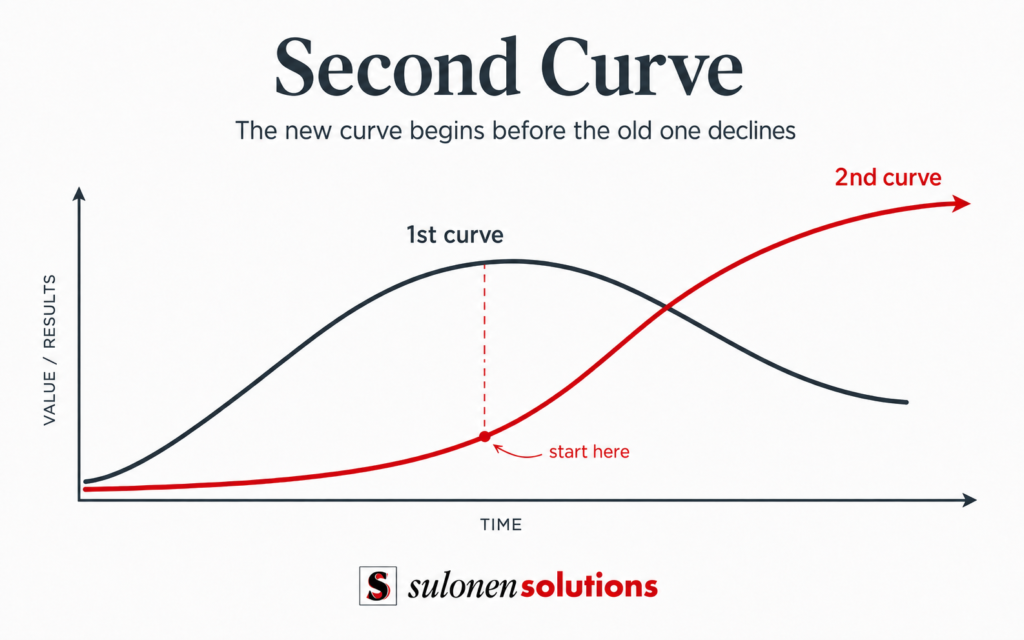
Charles Handy’s The Second Curve offers another perspective on this. Put simply, the idea of the second curve is that organisations – and people – should have the courage to build the next phase before the old way has been completely exhausted. If change is only set in motion once the first curve is plunging downwards, there are usually already fewer options available.
Throughout Handy’s thinking runs the need to challenge familiar structures and reinvent the future before circumstances force us to do so. I like the idea. For me, portfolio entrepreneurship is precisely this kind of second curve.
The first curve built my expertise. I was an employee. A supervisor. A salesperson. An executive. A CEO. An entrepreneur on the side.
Now the question is:
What happens if all that experience is no longer tied to a single organisation? What if the expertise accumulated over 25 years is used to solve the problems of several companies at the same time? To me, that is a far more interesting question than what title I might hold in my next job.
A portfolio is not an easier way to work
At this point, it is worth dispelling one potentially romantic notion. Portfolio entrepreneurship is not synonymous with freedom, a laptop and a cappuccino on a sunny terrace. Portfolio entrepreneurs have to build for themselves the machinery that an employer previously provided ready-made.
Sales.
Client acquisition.
Pricing.
Contracts.
Administration.
Calendar management.
Risk management.
Personal visibility.
And above all, securing the next assignment while taking proper care of the current ones.
Find a Fractional also highlights fluctuating income, the differing demands of clients, continuous business development and the danger of accidentally combining several fractional roles into one impossible 120% working week. A portfolio must therefore be managed like any other business.
This does not frighten me. Quite the opposite. There is a game in it. And I like games with lots of moving parts.
One career or an entire portfolio of expertise?
Perhaps the biggest change ultimately takes place in one’s own mind. In traditional working life, a person asks:
What am I?
A CEO?
A Sales Director?
A freight forwarder?
A consultant?
An entrepreneur?
With portfolio thinking, the question changes.
What do I know how to do, and what can I achieve?
To me, that is a much better question. I do not have to choose just one box. In one situation, I can be an interim executive. In another, a fractional Development Director. In a third, someone who builds sales. In a fourth, a coach. In a fifth, a trainer.
The role changes. The core expertise does not.
And perhaps that is precisely why the whole idea of portfolio entrepreneurship feels exceptionally natural at this point. I am not building an entirely new career for myself. For the first time, I am consciously assembling the pieces of the career I have already built.
Portfolio entrepreneurship, then, is not an escape from permanent employment for me.
It is a way to put 25 years of experience to work more effectively.
Perhaps, in the end, I did not switch from one career to another. Perhaps I simply stopped trying to fit myself into a single job.
P.S. In Finland, Pia Kiviranta is a strong advocate for these ideas. Her content and services are also well worth exploring: https://piadotsinterim.fi
Background and sources
Charles Handy: The Age of Paradox
Charles Handy: The Second Curve – Thoughts on Reinventing Society
Charles Handy’s thinking on the Shamrock Organisation and the portfolio career
London Business School: The Shamrock Organisation
FindaFractional: How to Build a Portfolio Career as a Senior Executive
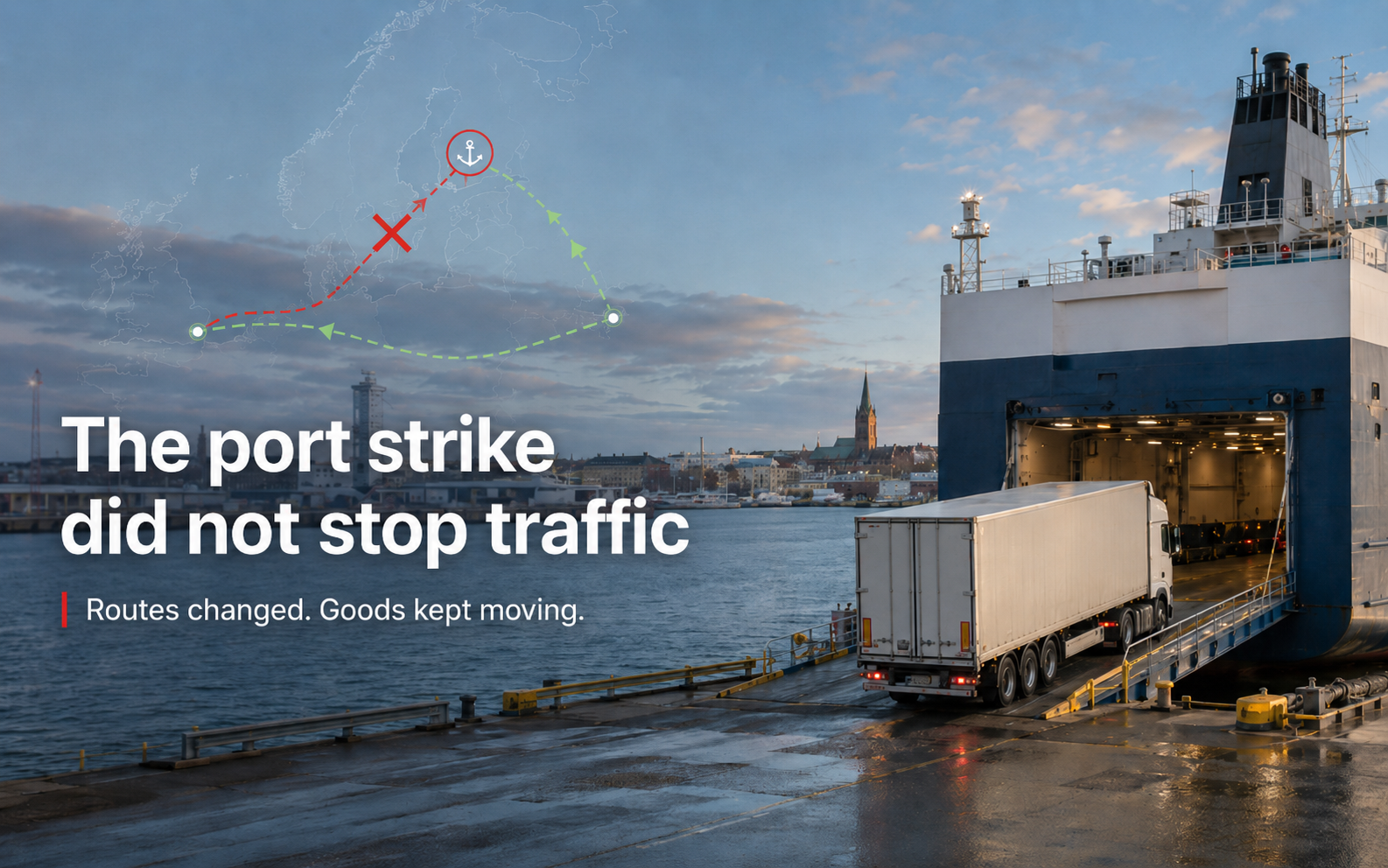
The stevedores’ strike was announced in bold headlines:
It will bring Finland’s ports and international traffic to a halt.
But did it?
No. At least not truck traffic. It did something much more interesting: it forced transport operators to find new routes.
From a logistics perspective, Finland is effectively an island. To get out of the country, goods need to travel by ship, whether in a container or on a truck.
Of course, you can also drive to Europe via Haparanda and Sweden, but in most cases it makes little commercial sense. It is cheaper and faster to drive onto a ferry and continue from there to Sweden, the Baltics, Central Europe or even the UK.
This was precisely the traffic that the stevedores’ strike was supposed to stop.
What does a stevedore actually do?
To understand the impact of the strike, you first need to know one thing:
Who drives the trailer onto the ship?
If both the tractor unit and the driver travel with the trailer, the answer is simple. The driver drives the entire combination onto the ship and off again at the destination port. But a large share of international trailer traffic works differently. In that case, only the trailer travels on the ship as an unaccompanied unit. The tractor unit and driver stay ashore.
The main reason is efficiency.
A trailer alone takes up around 14 lane metres on a ship. With the tractor unit, the whole combination requires around 17 metres. In addition, the driver needs a cabin or passenger accommodation, meals and other services – and above all, the driver spends hours sitting on the ship without actually performing transport work.
In unaccompanied trailer traffic, the same equipment can be used more efficiently.
The process can work like this:
A domestic haulier takes the trailer to the customer for loading and then delivers it fully loaded to the port. There, the trailer is uncoupled from the tractor unit and left waiting for shipment. A stevedore moves the trailer onto the ship with a terminal tractor and secures it.
At the destination port, a local stevedore pulls the trailer off the ship again and leaves it in the port area. After that, for example, a German haulier collects the trailer in Travemünde and delivers it to its final destination.
The driver changes.
The tractor unit changes.
But the same trailer keeps moving.
What happens if the stevedores stop working?
Unaccompanied trailer traffic stops.
But do the goods stop moving?
Not necessarily.
Business does not stop. It finds another route.
During a strike, the new route may be temporary. But if the disruption lasts long enough, the temporary solution can become the new normal. The port strike was a very concrete example of this.
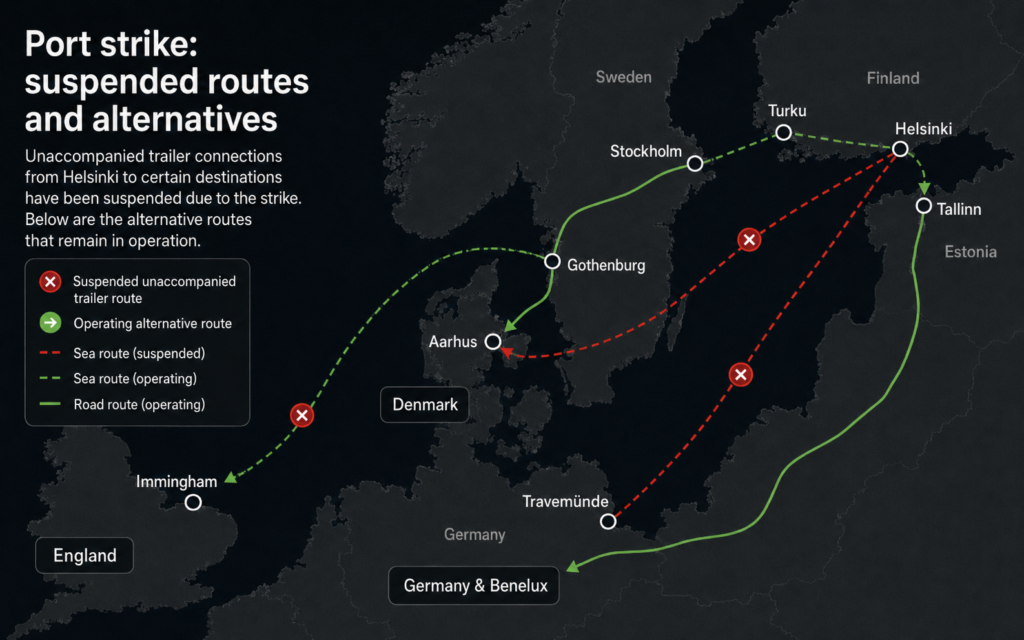
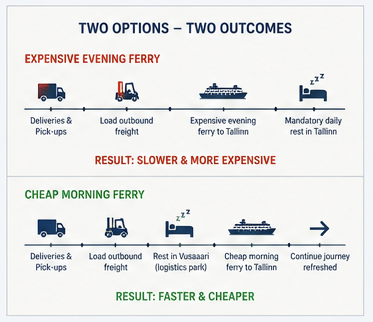
Alternative routings during the port strike.
Germany – via Tallinn
One of the most important routes between Finland and Central Europe is Helsinki–Travemünde. A large share of the freight on this route moves as unaccompanied trailers. When stevedores stop working, this type of traffic quickly becomes difficult.
An alternative, however, can be found on the other side of the Gulf of Finland. A large share of traffic to Tallinn consists of accompanied combinations with both tractor units and drivers. The driver drives onto the ship personally, so Finnish stevedores are not required in the same way.
So freight began moving via Tallinn. From Finland by ferry to Estonia, then by road through the Baltics and Poland to Germany. The strike in Vuosaari therefore did not stop Finland–Germany traffic.
It simply shifted some of it onto another route.
Sweden and Denmark – the driver travels with the truck
Traffic to Sweden largely works on the same principle.
Passenger and ro-pax ferries depart from Helsinki, Turku and Naantali carrying accompanied truck combinations. The driver drives the vehicle onto the ship and off again at the destination port. That is why traffic to Sweden continued quite normally during the strike. And from Sweden, it is still possible to drive onwards to Denmark. If the direct unaccompanied trailer connection between Finland and Denmark is unavailable, the goods do not necessarily remain in Finland.
They simply take a longer road route:
Finland → Sweden → Denmark.
The route is slightly more expensive – especially when heading to Jutland – because the ferry between Finland and Sweden still has to be paid for, and there are more kilometres to drive.
But the goods keep moving.
What about the UK?
This is where things became more interesting.
Finnlines’ and Transfennica’s UK traffic was largely based on unaccompanied trailers. When the stevedores left the ports, these connections effectively stopped.
But UK freight did not stop.
It was still possible to drive to Sweden, and Sweden has functioning ferry connections to the UK. One viable route ran via Gothenburg to Immingham.
In practice, the solution was this:
UK export trailers were taken from Finland to Sweden with a driver. From Stockholm or Kapellskär, the journey continued by road to Gothenburg, where the trailers were transferred onto a ferry to the UK.
But simply taking an export trailer to Gothenburg would have been poor use of both the driver and the equipment. So the return traffic was arranged at the same time. A Finnish haulier took a UK export trailer to Gothenburg and collected a UK import trailer arriving on the same connection for the return journey.
This meant the driver did not have to wait at the port or return with an empty truck.
Export load off.
Import load on.
And back to Finland.
The strike stopped one operating model – not the entire logistics system
The port strike undoubtedly caused delays, additional costs and a great deal of extra work.
Routes became longer. More drivers were needed. More fuel was consumed.
Transport planners had to make decisions in a matter of days that under normal circumstances might have been planned for weeks. But traffic did not come to a halt in the way public discussion might have suggested. When one route closed, freight forwarding found another.
When an unaccompanied trailer could no longer move, a tractor unit and driver were added.
When a direct ferry connection disappeared, the route was diverted through Sweden or the Baltics.
This is one of those things that people outside logistics rarely see. In the finished delivery, all you ultimately see is that the goods arrived. Behind the scenes, however, someone may have rebuilt the entire transport chain during the previous 24 hours.
Logistics does not always go according to plan.
Its job is to keep moving even when the plan no longer works. That requires professional freight forwarders with the networks and systems to make it happen.
CRM is one of the most important tools in business and sales. A brand-new tiny company needs one just as much as an old, large one. But what kind of CRM is best for a new company or a first-time entrepreneur?
There are CRM systems coming out of your ears: free and expensive, huge and tiny, and every flavour in between.
But especially for a small, entrepreneur-led company, what is the best CRM?
The one that actually gets used.
One that is easy, clear and fit for purpose.
No extra bells, whistles or other pointless fluff. The harder it is to use, the less it gets used.
The most important thing when choosing a CRM is to stop choosing a CRM. At least for starters. Turn the whole thing around: first analyse what I actually need the CRM for. What do I want to put in it? What do I want to see when I open it? In what format? Which data?
There is your CRM skeleton – and absolutely nothing else. Every extra gizmo bolted around it is pointless: it slows things down, gets in the way and ultimately makes people use the CRM less.
Many off-the-shelf CRMs try to be as versatile as possible, cover every imaginable need and provide a growth platform – for absolutely everything? That is why adopting almost any CRM package usually begins with two steps:
1. Strip away everything extra and unnecessary.
2. Adapt ourselves to the way the remaining skeleton works.
Both are daft. Especially number two: while the basic idea is the same in every CRM, each one still works slightly differently. A small entrepreneur-led company usually has a very strong way of working of its own: what I sell, how I sell it and how I want to track it. It works. So why should it be forced into some CRM process diagram carved in stone?
Why not simply build the CRM around the company’s own process – the one that already works best?
It´s doable.
I analysed the options and ended up with three different models:
1. A completely ready-made CRM, such as HubSpot or Pipedrive. Remove 70% and adapt our own way of working to whatever remains.
2. Build our own from scratch with Codex?
3. Hybrid model: choose an existing platform that is flexible enough, then use the working technology underneath to build our own CRM “from scratch” on top – containing only the functions I will actually use.
I went with option 3, and Airtable got the job. It is a browser-based cloud service: essentially an interface built on top of Excel-style tables, which can be used to generate different CRM systems – or pretty much any other tracking tool. Under the Sales/Marketing section, I found several ready-made CRM templates, each with a slightly different flavour.
And then I found the awe-inspiring button: “Create new +“. Click it and – surprise – a blank canvas opens. Then you start slapping this and that onto it with a very large paintbrush.
There is, however, an easier way: use AI and ChatGPT’s capabilities:
– Create a project in the Work environment
– Tell it which features I want in the CRM and which I do not (a precise list = a better result!)
– Ask the Terra or Sol engine to produce a plan based on my requirements
– Once I have approved the plan, ask the AI to guide me step by step through building the new CRM on Airtable
That is what this story is about.
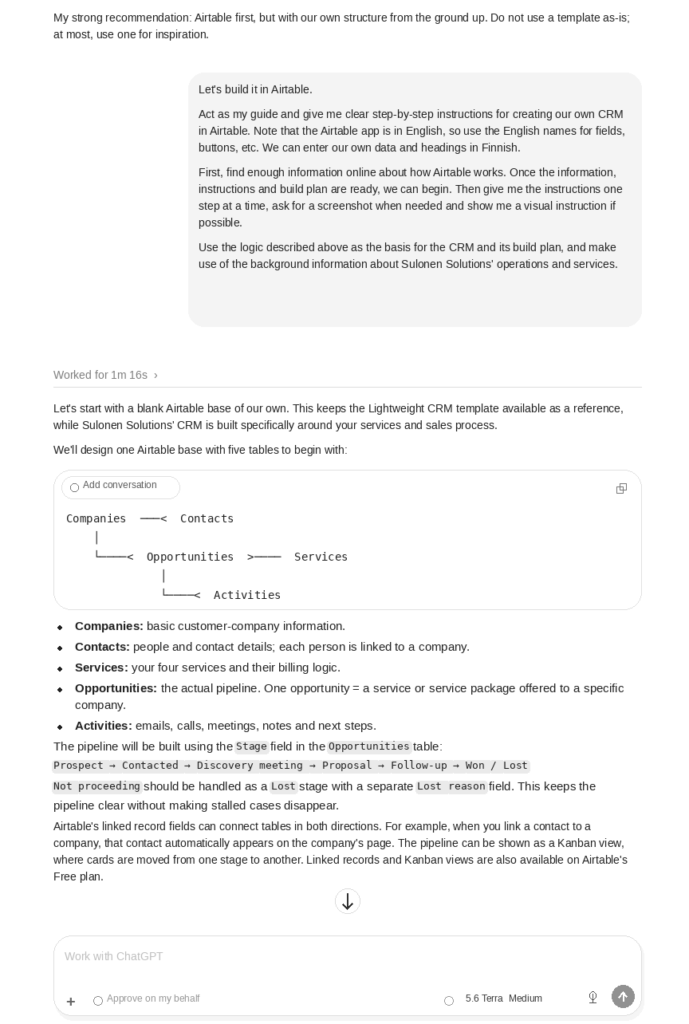
We started after morning coffee, at around nine, like this:
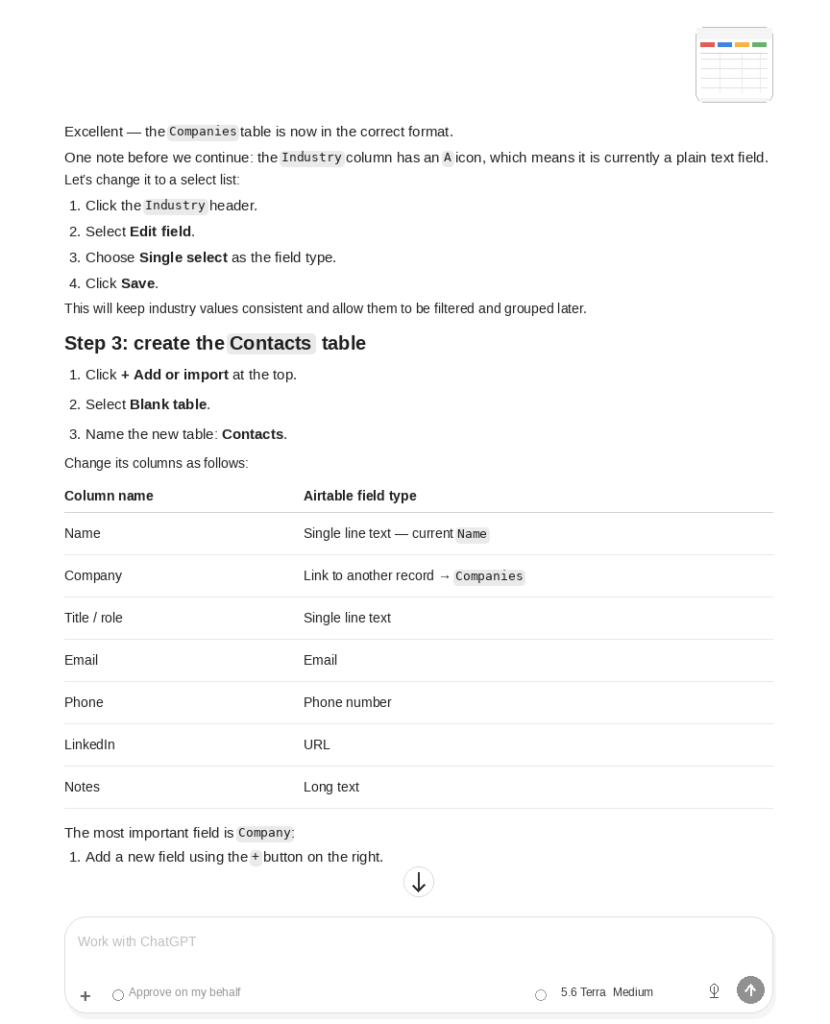
I tend to use screenshots in these projects -> ChatGPT can see what I have done on my screen and guide me when needed, as in the next example:
By 2:30 p.m., it was done. I also told ChatGPT to create a user guide for the CRM, lay it out on Sulonen Solutions’ official Word template, and save it in a specific folder on my Mac.
In between, I had already managed to go cycling, visit the library and stop at the supermarket on the way. Now it is done.
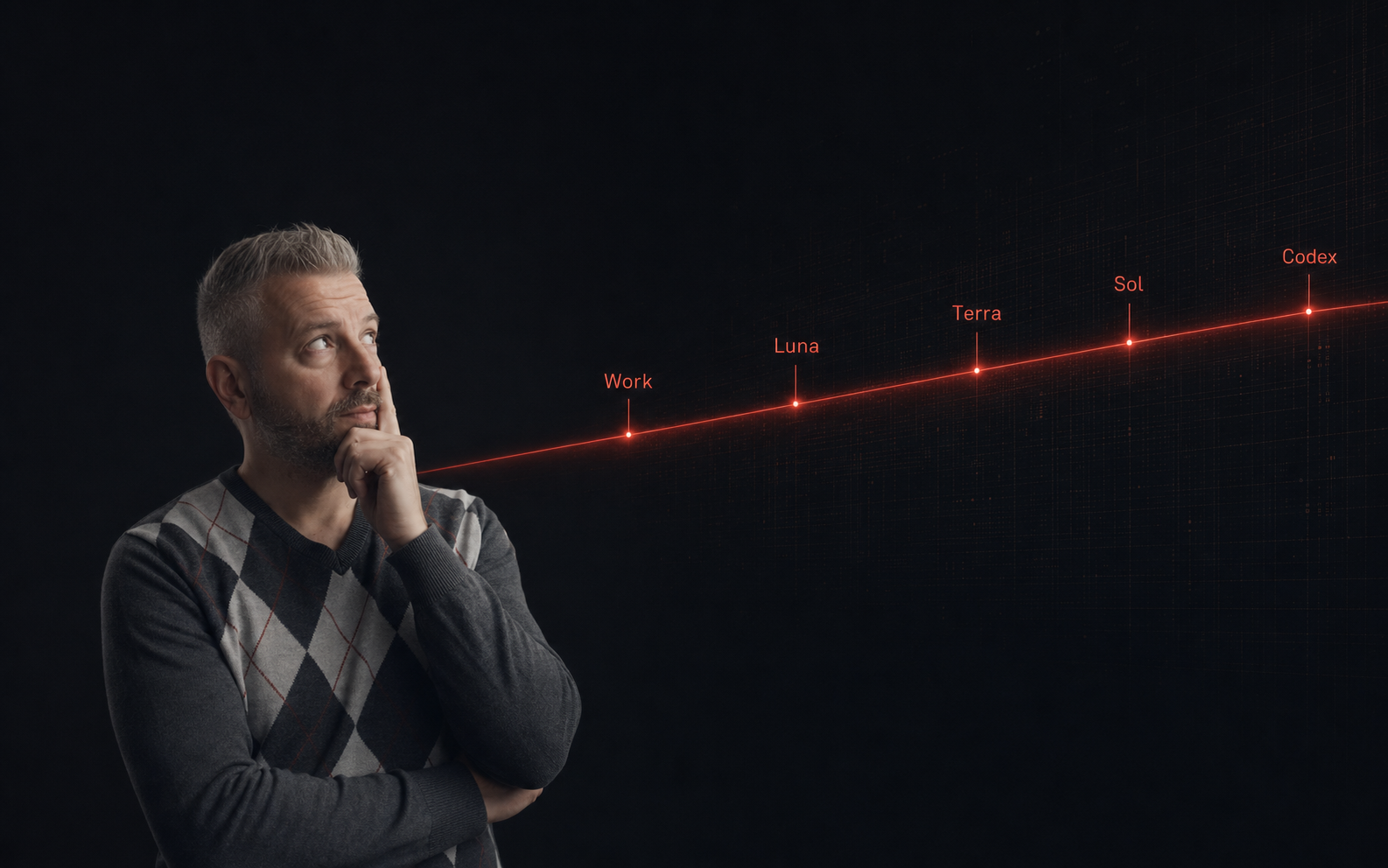
From chat on your phone to the Work workspace, from Luna to Sol, and from everyday questions to complete AI workflows.
Sulonen Solutions | 1 August 2026 | An up-to-date overview
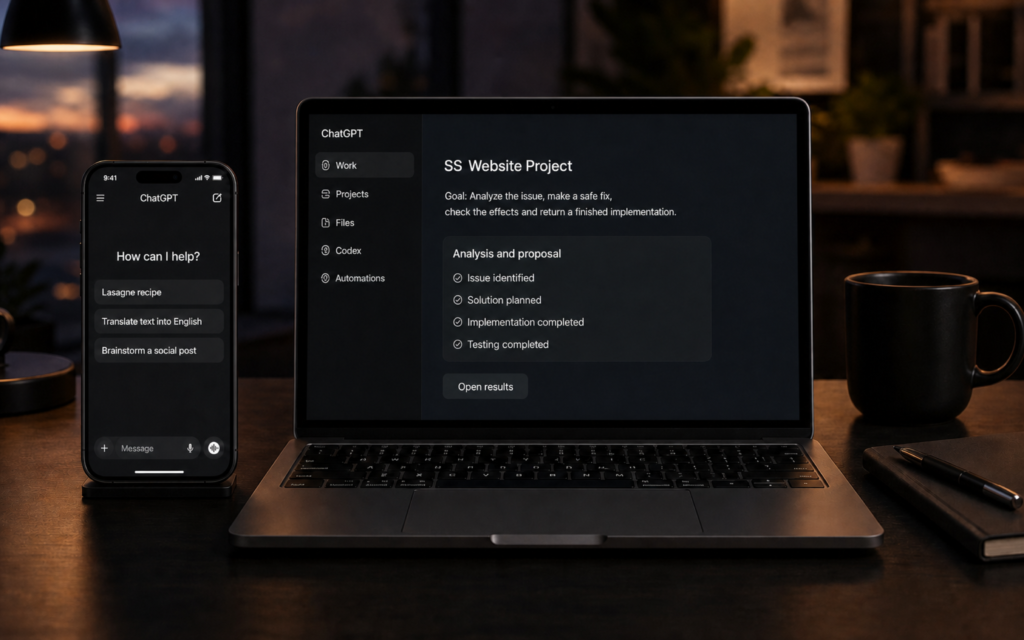
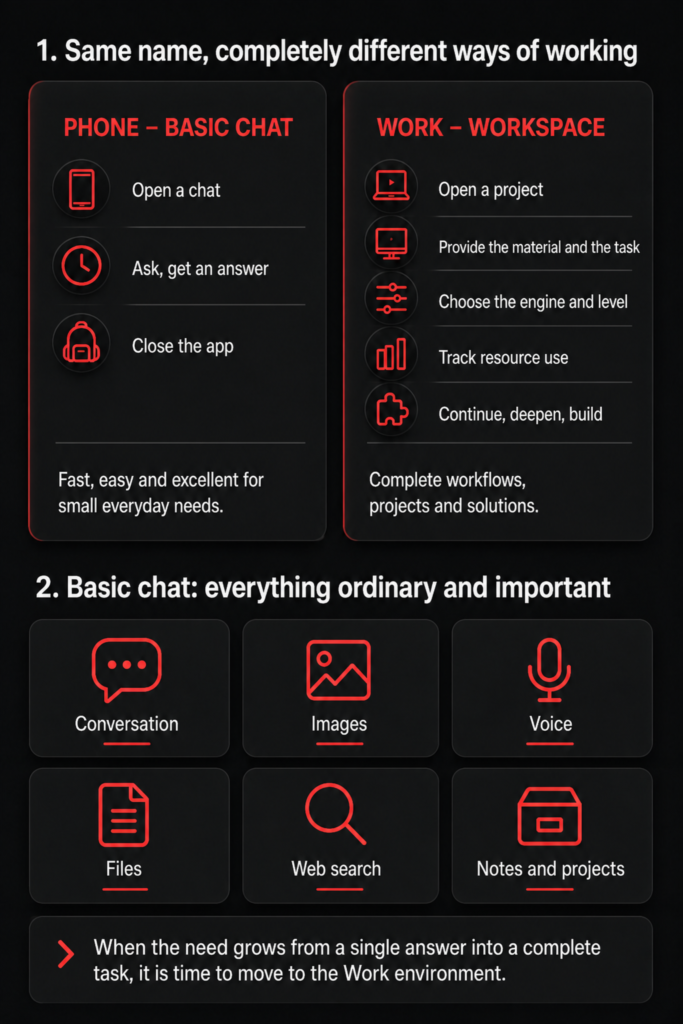
The ChatGPT mobile app and the desktop app for Mac.
I opened the same ChatGPT in two places – and got two very different machines
I opened ChatGPT on my phone. The screen showed the familiar blank conversation and one simple question: “How can I help?”
I opened the same service on my Mac in the desktop app (a local app, not through a browser). I was met by Chat, Work, Projects, Files, Codex, Automations, local folders, tools and several different engines. Same logo, same user account – but a desktop of an entirely different scale. And most importantly: the desktop app can be given access to folders on your computer. It can read material from your machine, produce finished documents, presentations and PDFs – and save them directly to the folder you want.
So was one the ordinary ChatGPT and the other an entirely different product?
No. And yes.
ChatGPT is no longer a single chat window. It is a family of tools that brings conversation, project context, files, web search, agent work, automation and software development together under the same name. In the current offering, OpenAI itself distinguishes three main experiences: Chat for questions and discussion, Work for research and producing finished deliverables, and Codex for software development. [1]
It is worth understanding this distinction before comparing models, tokens or credits. Otherwise, it is easy to try to solve the wrong problem with a tool – and then wonder why the work was slow, expensive or confusing.
1. Basic Chat has not gone anywhere
Ordinary Chat is still the familiar ChatGPT. You ask it questions, think with it, show it an image, give it a file and refine text with it round by round.
It is especially well suited to situations in which the work is still about thinking rather than execution:
questions and quick investigations
brainstorming and challenging alternatives
writing and editing texts
interpreting and generating images
web search
voice conversations
defining a task before the actual Work run
Basic Chat is light precisely because the user does not need to turn it into a project. Open a conversation, ask, assess the answer and continue.
Think in Chat. Execute in Work. Develop software in Codex.
The boundaries are not concrete walls. You can write code in Chat and ask a single question in Work. But when the way a tool is used matches the nature of the task, the outcome improves too.
Figure 1. The same ChatGPT name – two different ways of working.
2. Is Chat in the desktop app the same as Chat in the browser?
In practice, yes – but the operating environment is not the same.
Ordinary Chat in the new ChatGPT desktop app is the same Chat experience belonging to the same user account and cloud service. Chat conversations sync between the browser and the desktop app. The desktop app therefore does not contain a separate “second ChatGPT brain” that lives inside your Mac or Windows computer. [1]
The difference comes from the shell, permissions and tools connected around it.
The browser version is an easy general-purpose interface. It works without installation, and you can use Chat, projects and, depending on your account, Work and connected services there. The desktop app brings Chat, Work and a separate Codex view together in one application. In addition, with the user’s permission, Work can handle local files and desktop applications. [1][2]
The desktop app also has a built-in browser for Work and Codex tasks. The user and ChatGPT can view the same page, navigate tabs, download files and wait for the user to sign in to a service. The browser has its own browser session; it does not automatically use the sign-ins or cookies of ordinary Chrome. [3]
So the precise answer is this:
Chat in the desktop app is the same ChatGPT conversation. The desktop app as a whole, however, is a much broader working environment than a browser window.
3. Work is not just a longer ordinary chat
In ordinary Chat, I often ask for an answer. In Work, I give an objective.
The difference sounds small, but in practice it changes the entire structure of the work.
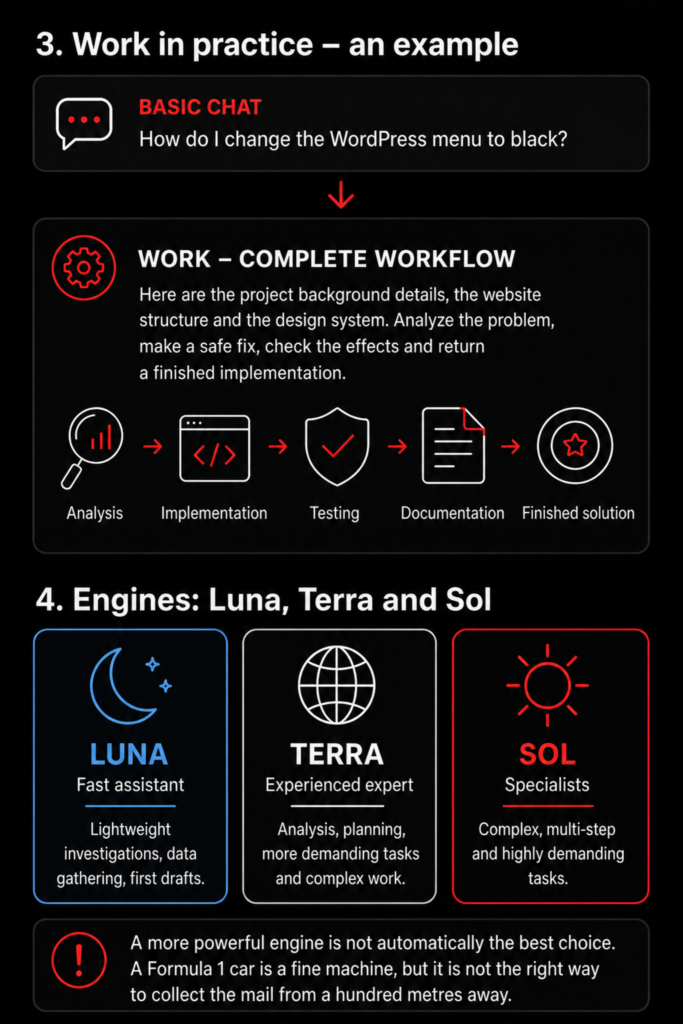
A Chat question could be:
“How do I change a WordPress mobile menu background to black?”
A Work task could be:
“Here are the site structure, the theme in use, the design system and the required files. Identify the structure causing the problem, make the smallest safe change possible, check its effect on desktop and mobile, document the change and return a finished implementation.”
The first asks for instructions. The second gives work.
OpenAI describes Work as an agent that gathers context, plans the approach and works across files, applications and tools to produce finished documents, spreadsheets, presentations, reports and websites. Work conversations done in the cloud can continue between the browser, mobile and desktop app. Local work tasks, in turn, may remain only on that particular computer. [1][4]
Work’s strength is not that it automatically writes a better individual paragraph. Its strength is the workflow:
gathering material
structuring the task
analysis
implementation
review
corrections
documentation
a finished file or other outcome
When a task grows from an individual answer into a complete piece of work, it is time to move to Work.
4. Luna, Terra and Sol are not three reasoning levels
At this point, the interface can easily start to look more like a space programme than a writing assistant.
The engine and the reasoning level are two separate controls.
In the GPT-5.6 family, Luna is the fastest and most affordable model, Terra is the balanced general-purpose model, and Sol is the flagship model for the most demanding tasks. In Work and Codex, Plus, Pro, Business and Enterprise users can, depending on their account and the rollout stage, choose between these three and separately set the reasoning level for the task. In ordinary Chat, Terra and Luna cannot be selected; GPT-5.6 Sol operates behind the reasoning options there, while GPT-5.5 Instant serves as the fast everyday default model. [5][6]
This is why the formula “Luna = fast, Terra = medium and Sol = high” should not be taken literally. It is a useful first rule of thumb, but technically the choice is two-dimensional:
How capable and expensive an engine does the task require?
How much time and computation is it worth using for this particular task?
Sol can be set to do a light run. In some environments, Luna can be given more time to reason. The most powerful combination is not automatically the best combination.
A Formula 1 car is a fine machine. Even so, it is not the right vehicle for fetching the post from a hundred metres away.
Figure 2. A Work task and the practical division of labour among GPT-5.6 engines.
5. What should you actually do with Luna, Terra and Sol?
There is no perfect boundary, because a task’s difficulty is not visible from its length. One short question can contain a difficult contradiction. An inventory of a hundred files, in turn, can be lengthy but mechanical work.
The following is a practical division of labour.
Luna – the fast assistant
Luna is suited to tasks where the structure of the work is clear and the cost of error is low:
file lists and material inventories
classification, extraction and organisation
summarising provided text
format conversion and mechanical cleanup
first drafts
repeated checks for which the rules are precisely defined
Terra – the experienced general-purpose model
Terra is the sensible default for most Work tasks:
analysis of several sources
plans and comparisons
ordinary expert reports
multi-step but scoped implementation
a technical review of a website or document package
building a finished draft from provided material
Sol – special forces
Sol is worth using when the task involves genuinely difficult inference or a high cost of correction:
unclear and contradictory source information
difficult root-cause analysis
a whole spanning several systems or files
technical solutions that change the architecture
a critical final audit
a situation in which the wrong solution creates a great deal of new work
Sol does not remove the need for review. It simply earns its place when a task genuinely needs its persistence and ability to manage complex wholes.
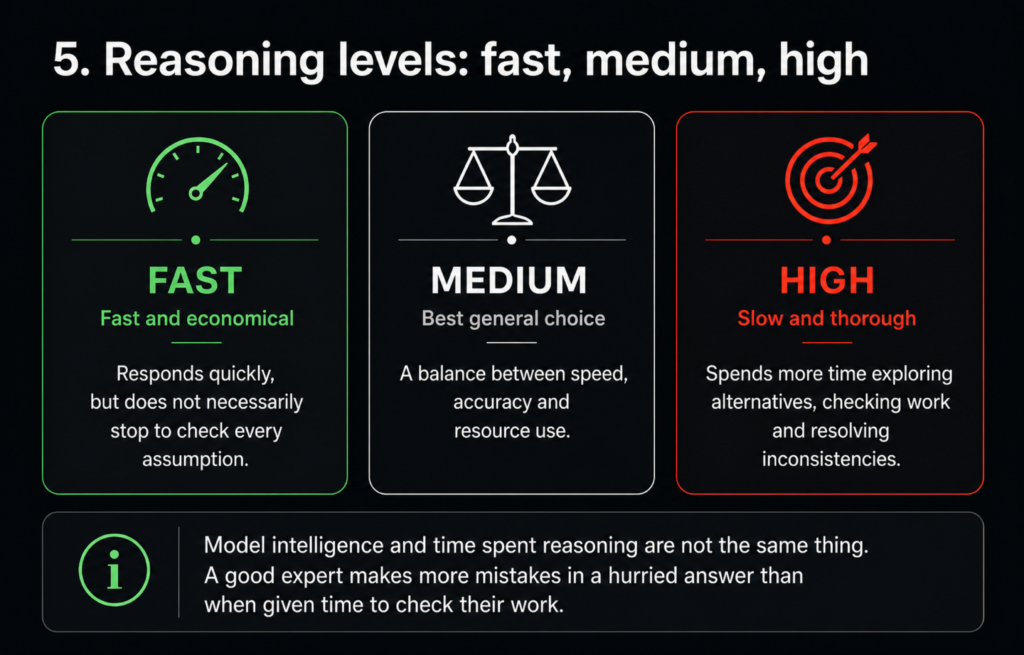
6. Reasoning level indicates time spent working – not intelligence alone
Current ChatGPT distinguishes fast responses and deeper reasoning more visibly than before. In ordinary Chat, the choices appear, for example, as Instant, Medium, High and, on some accounts, Extra High or Pro levels. OpenAI describes Medium as more considered than usual, and High as longer reasoning for complex, multi-step tasks. [7]
A fast level is suitable when the task is clear and the answer is easy to verify.
The medium level is a good default for expert work.
The high level should be reserved for situations where the model needs to:
compare several alternatives
identify contradictions
check its own work
solve a multi-step problem
take many constraints into account simultaneously
High reasoning is not magic dust. A poorly scoped task remains poorly scoped even if it is thought about for three times longer.
Let us take a practical example at this point:
Think of an essay written at comprehensive school. The lightweight Luna engine is like a basic-level essay writer. It will produce something finished, but not necessarily the top result in the class. The Sol engine, by contrast, is the class’s most innovative pupil with a broad knowledge base, who writes a first-rate and insightful essay by combining a great deal of knowledge learned over the year.
The reasoning level (Fast – Medium – Heavy), on the other hand, means the time that the same writer (engine) spends on the work. With fast (but light) reasoning, even the best writer in the class may make mistakes in their essay; some illogicality goes unnoticed, there is a typo somewhere… But the result was finished quickly. The heaviest reasoning model, in turn, means that the writer does not stop when the essay is complete – they read it through, check it again, read it a third time – by this stage a few errors have already been found and corrected. The finished essay is submitted only after it has been read through, corrected and fine-tuned many times.
Every AI engine does this same thing. At the highest reasoning level, AI does not quickly hand in unfinished work. Especially with the SOL model, you can see how it “stress-tests” its answer, turns it every which way, checks, compares, corrects, reads again and checks once more.
A model does not always need more time. First, it needs a better task.
Figure 3. The model and the reasoning level are two separate choices.
7. What consumes tokens – and what does not?
A token is a technical unit for processing text. A word can consist of one or more tokens, and punctuation, spaces and parts of words also affect the count. The model processes input tokens and produces its answer as new tokens. Some reasoning models also involve internal reasoning tokens. [8]
Tokens are used when the model processes content:
the request you write
relevant conversation history brought into the task
project instructions and other context
file content given for the model to read
text retrieved from a browser or connected services
the answer produced by the model
internal reasoning in some models
Simply opening the application, reading an old answer or browsing the conversation history is not a new model run. When you ask the model to read, assess, search for or produce something, resources begin to be used.
Images, audio, computer use and other tools also do not always turn directly into ordinary text tokens. They may have their own usage meters, tool calls or consumption that affects the shared agent allowance.
A long conversation does not automatically mean that the entire chain is billed word for word again on every turn. The system may use retrieval, summarisation and caching. Still, the general rule holds: the more relevant background the model has to read on every turn, the larger the input becomes. In API use, tokens read from cache are cheaper than new input, but they are not the same as zero consumption. [8]
8. Token, usage limit and credit are three different things
These are easily confused because the interface usually shows the user usage limits and credits – not the exact token count for an individual response.
A token is a technical unit of measurement.
A usage limit is the permitted amount of messages, reasoning or agent work included in a subscription during a given period.
A credit is a paid or administrative consumption unit that supports specific features after the subscription’s included usage or in an organisation’s shared consumption model.
A ChatGPT subscription and the OpenAI API are different products. In the API, usage is priced directly on the basis of the tokens processed by the model and tool calls. With an ordinary ChatGPT subscription, the user primarily operates within subscription-specific usage limits.
On Plus and Pro accounts, Codex, Work and, for example, ChatGPT for Excel may, depending on the account and feature rollout, use the same agent-work allowance. When included usage runs out, supported features may use purchased credits. OpenAI stresses that the available options are always shown on the account’s own Usage page, because feature availability changes as rollouts progress. [9]
This leads to a practical guideline:
Do not optimise only the token. Optimise the finished work.
The cheapest model is not cheap if the task has to be done three times. The most expensive model is not efficient if it spends fifteen minutes thinking about something Luna could have organised in two minutes.
9. This is how work should be broken down
A good Work task is not a huge wish. It is a managed work package.
A working rhythm looks like this:
1. Define the objective in Chat
First discuss what is actually being done. Define the outcome, risks, material and acceptance criteria. (This does not usually consume usage limits -> check your own subscription.) I often do the planning for an entire project from start to finish in Chat. We plan, assess, invent and reflect. Only when there is a need to produce a concrete finished document or programme, or to analyse a huge number of files and emails and return a report from them, do we have the Work environment do it, for example with Luna or Terra. I use Chat’s help for this too: I ask it to create a finished “prompt”, in other words a precise instruction for the Work agent. Chat can summarise our discussion up to that point and turn it into a strict instruction for the Work agent, so that it does not start improvising or doing unnecessary work.
2. Keep the material compact
Give Work only the necessary files and permanent project instructions. A hundred-page backstory does not help if the task concerns one CSS setting.
3. Start with an inventory
Luna can inventory the material, identify files and make the first classification. At this stage, do not fix everything yet. If you want to form an overall picture of material containing numerous emails, several folders of files and 30–40 individual documents, it is not worth immediately putting the whole mass through a SOL agent at the highest reasoning level. You can do it, but your Plus subscription’s weekly allowance will be full already… I tell Luna to read it through at the medium or high reasoning level and only produce a list of the materials, not an analysis yet. When you tell Luna this objective right at the start in the prompt, it does not analyse yet but only creates a finished “source list” in a form that Terra can easily continue from. Terra can then directly disregard 70% of the material that is not relevant and analyse only what matters.
4. Execute with Terra
Terra is suited to ordinary analysis, planning and scoped implementation. Ask for one clear delivery: for example, a corrected file, a finished article or a review report. Or ask for an analysis of the entire source material that you just “cleaned up” with Luna – saving tokens.
5. Escalate only the difficult part to Sol
When you encounter a contradiction, an unclear root cause or a broad chain of effects, move that specific problem to Sol. Do not move the whole project automatically. I often use SOL only after I have received a finished analysis, report or material from Terra. At that point, you can do the final stress test with SOL.
6. Separate implementation and review
Finally, request a separate review against the acceptance criteria. In critical work, the reviewer can be a separate run or a more capable model.
7. End the chain in a controlled way
Ask for a short summary: what was done, which files were changed, what remains open and what the next step is. When the objective or component changes, start a new chain. It is also good to switch chains regularly if the conversation has become long and already contains 50–100 questions and answers. If you make Chat “tow along” the context of the whole conversation, it slows down. In that case, ask it to create a “transfer package” and say that you are moving to a new chain. Chat can create, for example, a compact PDF or .md file that you can copy to the new chain and continue where you left off – but without the old burden.
One outcome. One responsibility. One checklist.
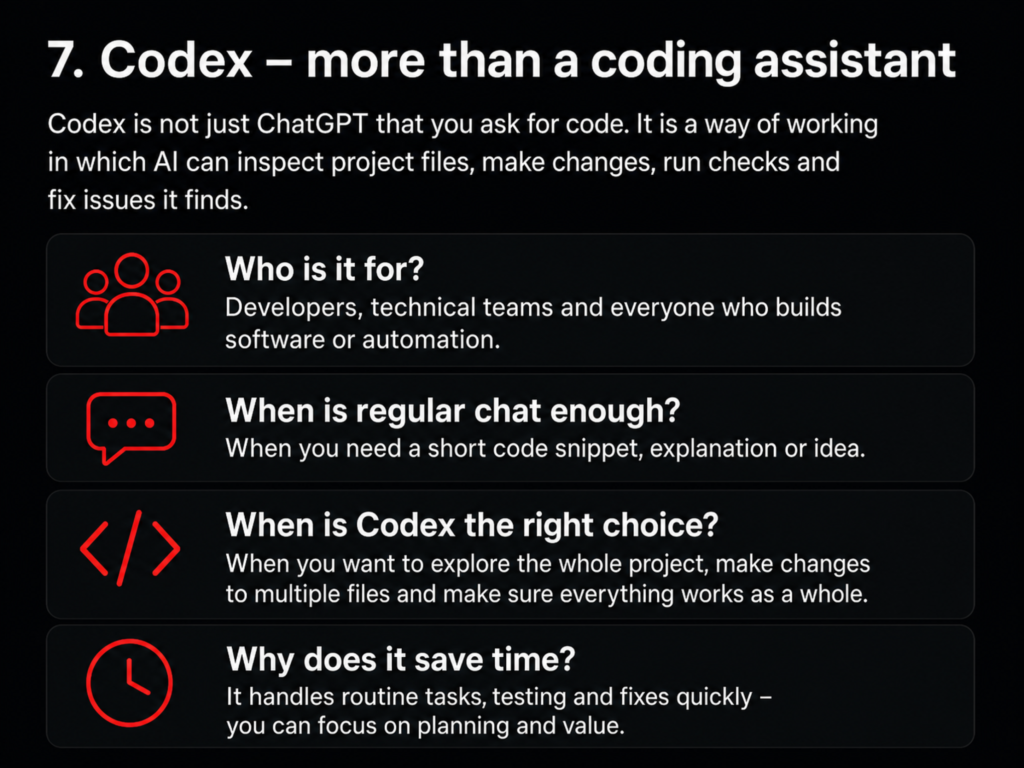
10. Codex is more than a chat that can write code
You can ask Chat for a snippet of code. Codex is used when the code needs to change in a real project.
Codex is a working environment that can use local folders, software repositories, the terminal and developer tools. It can make changes, run tests and commands, inspect differences, and go through the structure of a software project. Its history and work view are separate from ordinary ChatGPT history, and Codex is not selectable as an ordinary web or mobile view. [1][10]
When is ordinary Chat enough?
When you need a short code example, an explanation, an idea or an interpretation of a single error message.
When is Codex the right choice?
When you want to examine an entire project, make changes to several files, run tests, check dependencies and ensure that the whole still works after the change.
Codex saves time because the user does not need to transfer every file, error message and fix manually through a conversation window. It sees the worksite – not just one detached screw.
Figure 4. Codex is a project workspace, not merely a conversation that answers with code.
Summary: the right tool matters more than the biggest model
ChatGPT is not one window. It is a family of tools.
Chat is conversation, thinking and quick help. Work is a goal-oriented workflow that gathers material and produces a finished outcome. Codex is the desktop for software work, where changes can be made, tested and reviewed in a real project.
Luna is suited to light and well-defined tasks. Terra is a strong default for ordinary expert work. Sol is worth using when difficulty, uncertainty or the cost of error genuinely calls for it.
Reasoning level is not the same thing as the model name. A token is not the same thing as a credit. The desktop app is not a different ChatGPT – but it opens a considerably larger toolset for the same ChatGPT.
The best model is not always the most efficient model.
The best model is the lightest model that completes the work reliably.
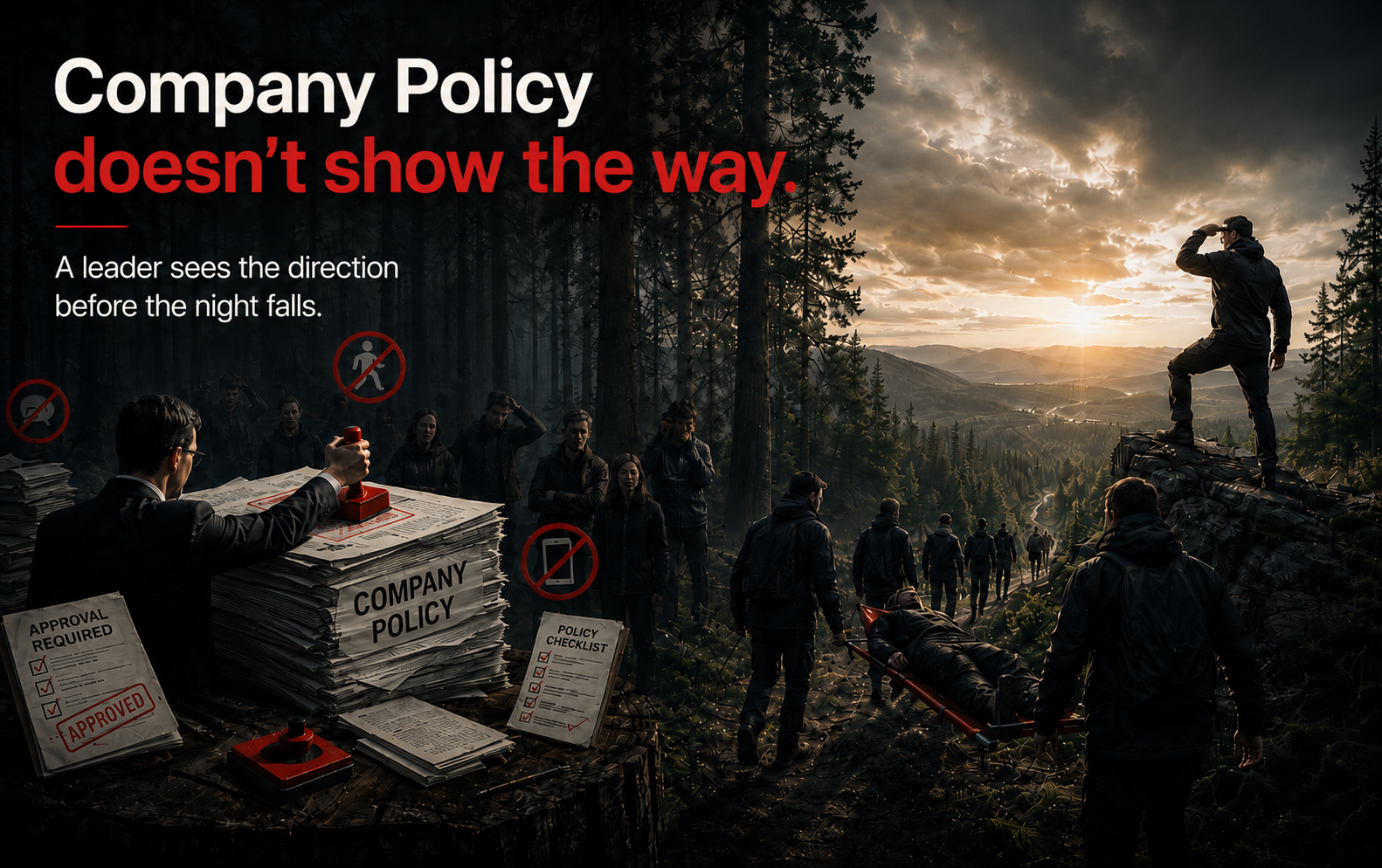
Both have become lost in the forest with their groups.
Evening is closing in. The temperature is dropping. One person has an injured leg, and another is already starting to lose hope.
They need to get out of the forest before nightfall.
The first leader looks around.
He sees a great many problems.
One person is standing in the wrong place. Another is holding the axe incorrectly. A third has taken three steps without prior approval. A fourth appears to be thinking for themselves.
The situation is serious.
The leader acts immediately.
– Do not touch the trees.
– Do not climb onto rocks.
– Do not leave the group.
– The axe may only be used with separate authorisation.
– Every step must be reported before it is taken, while it is being taken and, preferably, after it has been taken.
Especially afterwards.
Only then can it be assessed whether the step was permitted in the first place.
When direction is missing, the rulebook grows
The first leader does not know where they are.
He does not know which direction they should take.
He does not know how to bring the injured person along.
But he knows one thing for certain:
The current Company Policy is not long enough.
It needs a new appendix.
The appendix needs a sub-appendix.
And the sub-appendix needs a clarification on who is authorised to read the original appendix.
The forest around them grows darker, but the documentation improves by the minute.
This is important.
Because if the group freezes during the night, it can be demonstrated beyond dispute in the morning that this happened in breach of the instructions.
Everything was under control. Except the business.
Micromanagement looks like leadership from the outside.
There are plenty of meetings.
There are plenty of reports.
There are even more approvals.
The calendar is full of coloured boxes, emails ping around the clock, and the leader’s name appears in every thread.
Impressive.
Except that nothing moves.
Or if it does, nobody knows in which direction.
When results deteriorate, a poor leader does not necessarily stop to ask whether the strategy is flawed.
He asks why people are not following the rules even more precisely.
When the first control does not help, a second one is added.
When that does not help either, a working group is established to assess whether the controls are sufficient.
When the company makes a loss, the rulebook delivers growth.
So at least something is developing.
A prohibition is not a strategy
A poor leader feels safe when everything is forbidden.
Nobody can make a mistake if nobody is allowed to do anything.
Brilliant.
Sales is not allowed to make an unconventional offer.
Operational management is not allowed to solve a customer’s problem on its own initiative.
Local management is not allowed to decide a local matter.
Nobody may take a risk, exercise judgement or move forward until the matter has travelled sufficiently far away to people who know neither the customer, the situation nor the market.
If a decision takes three weeks and the customer leaves in two, the process has still succeeded.
Every rule was followed.
The customer simply behaved incorrectly.
The micromanager leads through fear
In the forest, nobody asks anymore:
– How do we get out?
Instead, they ask:
– Am I allowed to do this?
– With whose permission?
– What happens if I make the wrong decision?
– Who will get angry?
– Would it be safer to do nothing at all?
The final option is often the safest.
The organisation learns quickly.
Not to learn, experiment or solve problems.
But to protect itself.
People no longer consider what would make sense for the company, the customer or the outcome.
They consider which decision will leave the fewest fingerprints.
It is an effective way to build a company where everyone protects their own back and nobody takes responsibility for the whole.
A leader, on the other hand, sees the forest
The second leader looks at the same situation.
He sees the risks too.
He too sees the injured leg, the darkening sky and the wet terrain.
But he also sees something essential.
These trees form a forest.
The group is lost.
Night is approaching.
And they need to get out.
He climbs onto a rock.
Not because he wants to appear bigger than everyone else.
Not because he needs an audience.
And not because his title looks more impressive when he is standing on a rock.
He climbs higher because he can see further from there.
That is, incidentally, a surprisingly good test of leadership.
Some people rise higher in an organisation to see the bigger picture.
Others rise higher merely to make sure everyone else can see them.
A good leader asks the right question first
He does not begin by asking who broke a rule.
He begins with this:
– What is the situation?
Then this:
– What is the most important objective?
And finally this:
– What do we need to do now?
A surprising number of leadership problems would already be solved if these three questions were asked before the first order was given.
But that requires thought.
Handing out rules is easier.
Everyone shares the same direction, not the same task
The second leader knows his group.
The two strongest members build a stretcher from trees and jackets.
The fastest person goes slightly ahead to inspect the terrain.
The best navigator keeps the group on course.
The calmest person walks beside the injured member.
Someone carries the equipment.
Someone keeps track of time.
Someone makes sure nobody is left behind.
Everyone is doing something different.
Yet everyone is moving in the same direction.
This is leadership.
A poor leader tries to make people identical to one another.
A good leader turns their differences into a competitive advantage.
Trust looks dangerous to a control freak
A good leader does not inspect every knot personally.
He does not dictate the position of every foot on every step.
He does not require the scout to request approval for every change of direction.
He defines the objective, the boundaries and the responsibility.
Then he lets people do their jobs.
To a control freak, this looks careless.
But what if someone makes a mistake?
Good question.
Someone probably will.
But a leader understands that people do not develop without making decisions.
An organisation does not develop if every decision is sucked up to the top floor.
And a business does not develop if the only permitted course of action is to wait.
Mistakes cost money.
But so does an inability to decide.
Often far more.
Losses are not fixed by adding fear
If a company does not know where it is going, closer supervision of its employees will not provide it with a strategy.
If customers are being lost, additional approval layers will not bring them back.
If the local market is not developing, removing local decision-making authority will rarely improve the situation.
If capable people start leaving, it may not be because they failed to understand the latest policy appendix.
Sometimes they leave precisely because they did understand it.
A loss-making company might perhaps ask:
– What do our customers need?
– What are we good at?
– Where are we failing?
– What do we need to change?
But control-based leadership asks:
– Who made the decision without permission?
That is an excellent question if the objective is to find someone to blame.
A poor question if the objective is to find a way out of the forest.
An organisation led through fear stops telling the truth
This always happens gradually.
At first, people report problems.
Then they notice that the person who raised the problem is made to explain the problem themselves.
Next time, the problem is phrased a little more attractively.
Then the most difficult parts are removed.
Eventually, the report states that the situation is under control.
The company is standing in the middle of the forest, but the PowerPoint shows a green arrow pointing upwards.
The leader is pleased.
Green is a good colour.
The only minor challenge is that nobody dares to mention that the sun set an hour ago.
Company Policy can protect the company
Or the leader from the company.
Good guidance makes work easier.
It explains where the boundaries lie and helps people make better decisions.
Poor guidance is often written afterwards to conceal a lack of leadership.
When direction is unclear, a process is written.
When responsibility is unclear, an approval matrix is written.
When trust is absent, a control model is written.
When results fail to appear, a report is written explaining why somebody else failed to follow the model.
The paperwork increases.
Movement decreases.
A leader does not need to know everything
But a leader must understand what matters.
He does not need to be the strongest carrier in the group.
He does not need to be the fastest runner.
He does not need to navigate better than the navigator.
A leader’s job is not to outperform every employee at their own work.
A leader’s job is to get the best people to apply their expertise in the same direction.
This sounds simple.
That is exactly why it is so difficult.
It requires a leader to accept that somebody else knows more about something.
And not everyone is capable of that.
In the end, both groups produce a result
The first group spends the night in the forest.
Everyone knows exactly what they are not allowed to do.
Every decision has been documented.
Every deviation has been recorded.
And in the morning, an internal investigation is launched into why the group failed to achieve its objective.
The second group gets out before dark.
Not every original plan was followed.
The route was changed.
People made their own decisions.
Someone used the axe without three-stage approval.
A complete administrative disaster.
Except that everyone made it to safety.
A leader sees the forest
People in companies do not usually literally freeze to death.
They merely lose customers, money, capable people and years.
More slowly.
More neatly.
In accordance with approved processes.
The micromanager notices every branch placed incorrectly.
The leader notices that the entire group is lost.
And when night is approaching, the company does not need another prohibition.
In motocross, staring at the front wheel makes the rider crash. In leadership, the same thing happens a little more slowly – and usually at a much higher cost.
A young motocross rider approaches a corner. The track is full of ruts, bumps and loose stones. The bike moves beneath them, and the first natural reaction is to look down.
Their gaze drops to a metre in front of the bike. Sometimes almost as close as their own front fender.
Then the ride starts to become unstable.
The bike wobbles towards the inside of the corner, balance falls apart and the riding line begins to wander uncontrollably. The rider tries to manage every stone, hole and movement of the front wheel separately. The more they try to correct the situation, the more unsettled the riding becomes.
To a beginner, the solution sounds almost absurd:
Stop staring at the front wheel. Lift your eyes and look where you are going.
The front wheel will follow
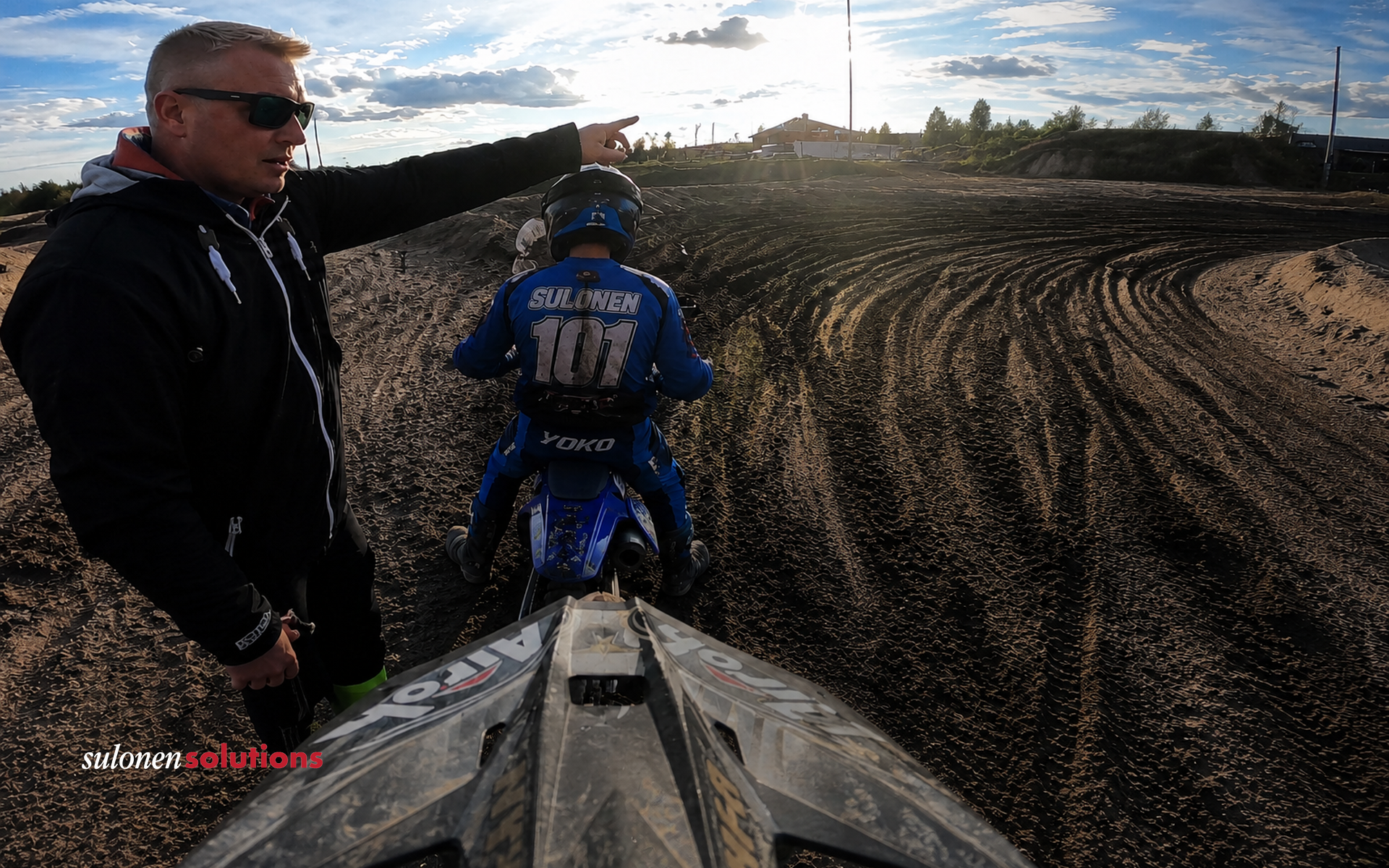
I led the junior division at Vantaa Motor Club and coached young riders at our motocross school. When teaching cornering, I often repeated the same instruction.
I might stand beside the track 20–30 metres beyond the corner and shout:
– I don’t want to see the peak of your helmet. I want to see your goggles – all the time! – Look at me as you enter the corner. Look at me as you come out of it! – The front wheel will stay attached to the bike even when you aren’t staring at it constantly!
When the rider dared to lift their eyes from the front fender and lock their gaze on the exit of the corner, something surprising happened.
The ride became stable.
The wobbling decreased, the bike stayed on its line and accelerating out of the corner became calmer. The rider was already able to prepare for the next straight and the next jump instead of still fighting with the hole the front wheel had crossed a second earlier.
The best moments were the realisations after the corner:
– Hey Ville, did you see that? That went really well! I was going really fast, and I didn’t wobble at all!
Yes I did. Now it went very well!
You ride where you look.
Focus is more than concentration
By focus, I mean consciously directing your attention towards something or a particular goal. It is not simply the ability to finish one task without being distracted by a phone beeping beside you.
Focus is a framework that guides action.
It determines what we consider important, where we spend our time and what we begin to notice around us. That is why focus shapes the outcome in sport, business and life in general.
Where are we looking?
What are we searching for?
What are we reinforcing with our attention?
And above all: are we looking where we are going – or are we still staring at the stone we have already ridden over?
A leader’s vision must reach the furthest
The same principle applies in business.
First, the direction and destination are decided. They may be defined by the strategy, budget, sales targets and most important KPIs.
Then everyone keeps their eyes in that direction.
This does not mean that problems should be ignored or mistakes left uncorrected. In motocross, you do not close your eyes to the holes in the track either. You take them into account, but you do not make them the purpose of the entire journey.
A leader’s job is to see beyond the individual hole.
The higher you operate within an organisation, the further ahead your vision should reach. Someone in the management team must be able to see the next corner. The CEO should already be able to see the straight beyond it.
At its purest, leadership is exactly this:
There must be someone in the group whose vision reaches furthest towards the goal.
Someone who ensures that the shared direction remains clear even when everyone else’s attention inevitably drops to the problems of the day, individual customer complaints and operational details.
When a leader starts staring at the front fender
Leadership begins to wobble the moment irrelevant details become more important than the direction.
Imagine a leader spending their time investigating why one employee’s phone bill was 52 € last month while another employee’s was 48 €.
The issue may technically be real. Perhaps a four-euro difference can be identified. A meeting can be arranged, an explanation requested and a new approval procedure created.
Meanwhile, the market is changing, an important customer is considering a competitor and the next jump that matters to the business is rapidly approaching.
But the leader’s attention is still fixed on those four euros.
The front wheel passed over the stone a long time ago. Staring at it will no longer change the direction of the bike. It will only ensure that the rider fails to notice the next hole.
This is not precision.
It is a loss of focus disguised as precision.
Leading through the rear-view mirror is even more dangerous
Another dangerous habit is focusing almost entirely on what has already happened.
Why did last year’s result fall short of the target?
Who made the mistake?
Why did we do things differently before?
Who approved the decision three years ago?
The past should be examined when it can teach us something that will help us in the future. But the past should not be confused with the destination.
Imagine riding a motocross bike down the main straight at full speed while constantly looking backwards.
I have not tried it. And I do not intend to.
There are easier ways to end up in hospital.
Yet this is exactly how organisations are led. Meetings fill up with explanations, old failures and stories about how things used to be. Everyone is staring so intently into the rear-view mirror that no one can see where the road ahead is turning.
Learn the lesson from history.
Then lift your eyes and look ahead again.
What you focus on grows
There is an old saying:
What you focus on grows.
In leadership, this becomes very tangible.
When a leader constantly focuses on past mistakes, possible failures and everything that must not happen, the organisation begins to do the same.
The workplace learns to avoid mistakes instead of pursuing success.
Decisions are no longer based on what would move the company forward, but on what is least likely to leave someone accountable later.
People spend their energy protecting themselves, preparing explanations and justifying decisions that have already been made. Eventually, most of the organisation’s resources are devoted to nurturing the very outcome it wanted to avoid.
The organisation no longer has a clear direction in which it wants to go.
It only has a long list of places where it does not want to end up.
That is a crucial difference.
Focus does not remove problems – it puts them into perspective
Good focus does not mean pretending to be positive or sweeping problems under the carpet.
It means addressing problems in relation to the goal.
If a mistake prevents us from reaching the destination, we correct it.
If a process slows the operation down, we improve it.
If an indicator points in the wrong direction, we respond.
But not every stone needs to be placed on the conference-room table for examination. Not every deviation is a strategic crisis, and not every four-euro difference deserves the attention of the management team.
A leader’s most limited resource may not be money.
It is attention.
Where a leader directs their attention, the organisation’s time, conversations and energy will soon follow.
That is why choosing where to focus is always a leadership decision.
Where are you looking?
Look down, and you will start seeing nothing but holes.
Look back, and you will see only what has already happened.
Look ahead, and you can still influence what happens next.
A leader does not need to know the exact location of every stone on the track. But they do need to know which direction the organisation is heading, where the next corner is and which jump the entire organisation should be preparing for.
What happens next? – A simple question that reveals an incomplete view of the whole.
One of the fundamentals of leadership is seeing the bigger picture. That famous helicopter view, from which all the small stuff spinning around you begins to shrink and the essential becomes visible:
What is actually happening here?
One of the tools I use for this is a very simple question:
What happens next?
I often use it myself when designing operating models, processes and wider business solutions.
The question causes a surprising amount of confusion.
It forces you to shift your attention from the individual task at hand to the entire chain of events. To what happens after the decision has been made – and what happens after that.
Small pieces will always form some kind of whole. Whether they form a functioning whole, however, is usually determined only a couple of steps later.
Still a little too abstract?
No problem. Let’s make it practical.
Accompanied road freight via Tallinn
When I previously worked as Road Director for the Finnish subsidiary of an international freight forwarding company, I had the following discussion with one of my employees about our Eastern European road freight operation.
The traffic moved via Tallinn as accompanied units, rather than traditional unaccompanied trailer traffic.
In practice, the same driver and tractor unit remained attached to our trailer throughout the journey. A driver could leave Finland with a load bound for Poland, Slovenia or Italy, for example, and return to Finland with the same combination a couple of weeks later.
At the time, we made extensive use of the ferries between Helsinki’s West Harbour and Tallinn. Departures were frequent, and the afternoon and early-evening sailings from Helsinki were naturally the most popular.
The logic was easy to understand.
The driver arrived in Finland from Tallinn in the morning, delivered the inbound loads to customers and then began collecting and loading new outbound freight. Once the truck was ready in the afternoon, the aim was to get it back to Tallinn as quickly as possible and from there onwards towards Central or Southern Europe.
That is why the cheapest morning ferry could cost less than €200, while the most popular evening departures between 16:00 and 18:00 could cost €600–700 per truck.
This gave me an improvement idea, which I began testing with one of my employees.
– Why are you sending the driver out on the most expensive evening ferry?
– So that he can reach the mainland again on the same day.
– But why?
– Well… so that we get a faster schedule. We’ll reach somewhere like Poland sooner.
– Good idea. But what happens next? What happens after you have sent the driver to Tallinn?
– Well, he drives off the ferry and continues the journey…?
Except he doesn’t.
Driving time and working time are not the same thing
At this point, you need to understand the basic principles of drivers’ hours regulations.
Driving time and actual working time are two different things.
As a general rule, daily driving time is nine hours, and the required breaks must be taken during the driving day. Driving time is accumulated while the vehicle is moving.
A driver’s working day, however, does not consist solely of driving.
When the driver is loading at a dock, unloading at a customer, handling paperwork or waiting at a terminal, driving time may not be running – but working time is.
Drivers “working time” is not directly set in legislation, but mandatory 11h daily rest gives us even with short math – a daily working time of 13hours, and nothing more.
When the driver had arrived in Helsinki on the morning ferry from Tallinn and started the day at around 07:00, the working day was effectively over by the evening after completing the inbound deliveries and loading the outbound freight. Meaning: 20:00 you have to start your daily 11h rest.
Even though we had bought an expensive evening ferry ticket, the journey did not continue from Tallinn towards Poland.
The driver drove off the ferry and began the daily rest period.
– Okay. So the driver arrives in Tallinn, but in practice the journey goes no further than driving off the ferry, because he has to take his mandatory daily rest?
– Err… now that you mention it, I suppose that is exactly what happens.
– Exactly.
So now we have sent the driver to Tallinn on the most expensive ferry possible – just to sleep.
What if rushing actually slows the journey down?
What if, after loading, we sent the driver to Vuosaari instead?
The driver could take the daily rest period there in peace. Vuosaari has spacious truck parking areas and practically all the services a driver needs during a break, including shops and refuelling facilities.
The following morning, the driver would take an inexpensive morning ferry to Tallinn.
At first glance, the outcome seemed slightly counterintuitive:
the driver was able to begin the daily rest period earlier
there was no unnecessary rush during the day’s loading operations
the ferry ticket cost considerably less
the driver was rested and ready to continue immediately after arriving in Tallinn
the truck could reach its final destination even earlier than the one sent on the expensive evening ferry
The driver we had rushed to Tallinn the previous evening might still have had one or two hours of mandatory daily rest remaining the following morning.
The driver arriving on the morning ferry, by contrast, could continue directly from the port towards Poland.
The expensive option looked fast, but it was slow.
The cheap option looked slow, but it was fast.
What did this mean in euros?
Let’s take a simple example.
If a freight forwarding company has 20 weekly crossings from Helsinki to Tallinn and ten of them can be moved from the expensive evening departure to the inexpensive morning ferry:
€700 − €200 = €500 saved on one crossing
10 trucks per week = €5,000 saved per week
Over four weeks = approximately €20,000 saved per month
And the service did not become slower.
In the best-case scenario, it became faster.
What happens next?
This is what I mean by the “What happens next?”
way of thinking. An individual decision can look perfectly sensible when viewed only from the exact point at which it is made.
The expensive evening ferry looks fast.
Rushing looks efficient.
An early departure looks like good customer service.
But when the chain of events is examined a couple of steps further ahead, the meaning can be turned completely upside down.
In this case, rushing did not get the shipment to its destination any faster.
It sent the driver to Tallinn to sleep – at an extra cost of €500.