Imagine two leaders.
Both have become lost in the forest with their groups.
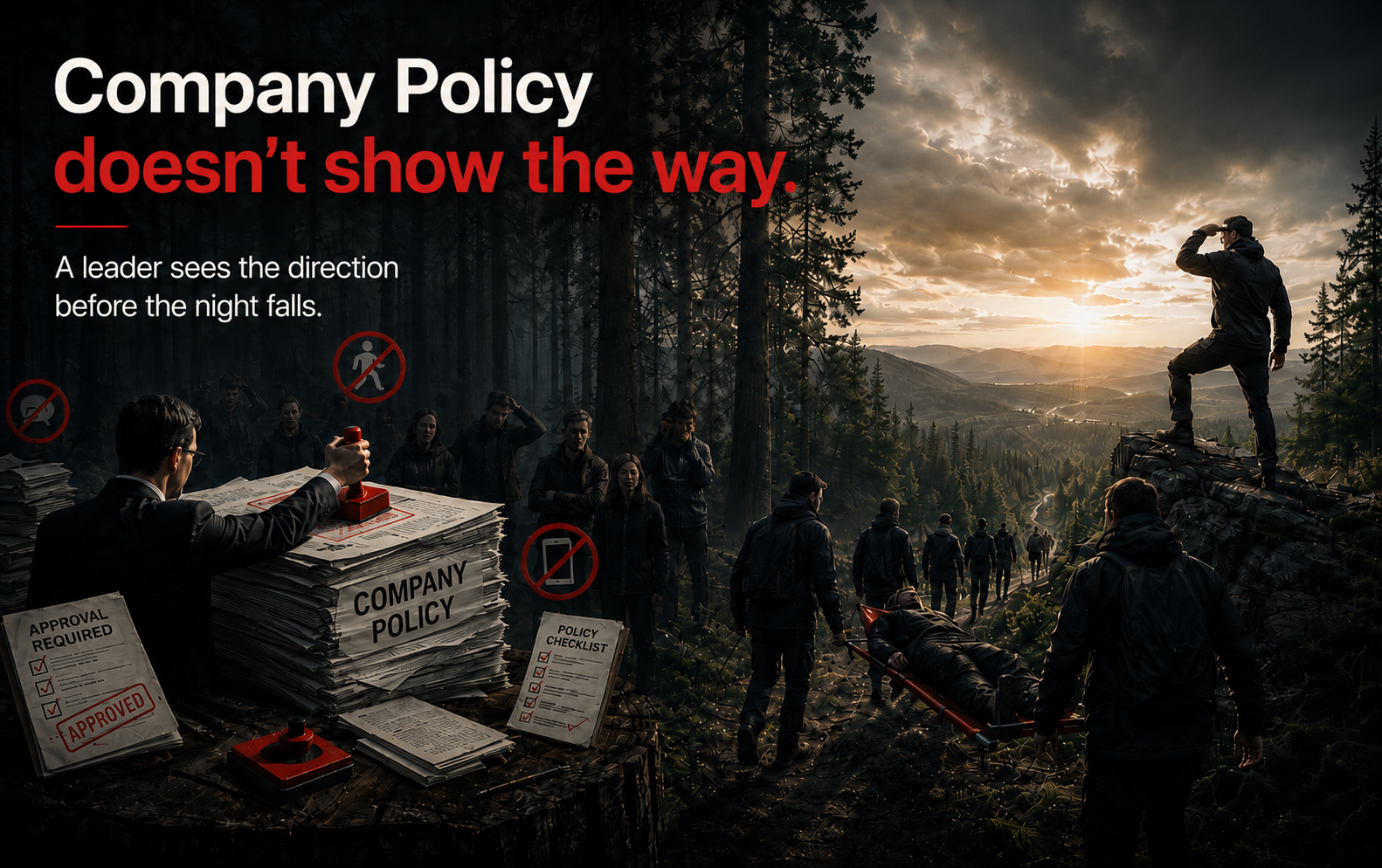
Evening is closing in. The temperature is dropping. One person has an injured leg, and another is already starting to lose hope.
They need to get out of the forest before nightfall.
The first leader looks around.
He sees a great many problems.
One person is standing in the wrong place. Another is holding the axe incorrectly. A third has taken three steps without prior approval. A fourth appears to be thinking for themselves.
The situation is serious.
The leader acts immediately.
– Do not touch the trees.
– Do not climb onto rocks.
– Do not leave the group.
– The axe may only be used with separate authorisation.
– Every step must be reported before it is taken, while it is being taken and, preferably, after it has been taken.
Especially afterwards.
Only then can it be assessed whether the step was permitted in the first place.
When direction is missing, the rulebook grows
The first leader does not know where they are.
He does not know which direction they should take.
He does not know how to bring the injured person along.
But he knows one thing for certain:
The current Company Policy is not long enough.
It needs a new appendix.
The appendix needs a sub-appendix.
And the sub-appendix needs a clarification on who is authorised to read the original appendix.
The forest around them grows darker, but the documentation improves by the minute.
This is important.
Because if the group freezes during the night, it can be demonstrated beyond dispute in the morning that this happened in breach of the instructions.
Everything was under control. Except the business.
Micromanagement looks like leadership from the outside.
There are plenty of meetings.
There are plenty of reports.
There are even more approvals.
The calendar is full of coloured boxes, emails ping around the clock, and the leader’s name appears in every thread.
Impressive.
Except that nothing moves.
Or if it does, nobody knows in which direction.
When results deteriorate, a poor leader does not necessarily stop to ask whether the strategy is flawed.
He asks why people are not following the rules even more precisely.
When the first control does not help, a second one is added.
When that does not help either, a working group is established to assess whether the controls are sufficient.
When the company makes a loss, the rulebook delivers growth.
So at least something is developing.
A prohibition is not a strategy
A poor leader feels safe when everything is forbidden.
Nobody can make a mistake if nobody is allowed to do anything.
Brilliant.
Sales is not allowed to make an unconventional offer.
Operational management is not allowed to solve a customer’s problem on its own initiative.
Local management is not allowed to decide a local matter.
Nobody may take a risk, exercise judgement or move forward until the matter has travelled sufficiently far away to people who know neither the customer, the situation nor the market.
If a decision takes three weeks and the customer leaves in two, the process has still succeeded.
Every rule was followed.
The customer simply behaved incorrectly.
The micromanager leads through fear
In the forest, nobody asks anymore:
– How do we get out?
Instead, they ask:
– Am I allowed to do this?
– With whose permission?
– What happens if I make the wrong decision?
– Who will get angry?
– Would it be safer to do nothing at all?
The final option is often the safest.
The organisation learns quickly.
Not to learn, experiment or solve problems.
But to protect itself.
People no longer consider what would make sense for the company, the customer or the outcome.
They consider which decision will leave the fewest fingerprints.
It is an effective way to build a company where everyone protects their own back and nobody takes responsibility for the whole.
A leader, on the other hand, sees the forest
The second leader looks at the same situation.
He sees the risks too.
He too sees the injured leg, the darkening sky and the wet terrain.
But he also sees something essential.
These trees form a forest.
The group is lost.
Night is approaching.
And they need to get out.
He climbs onto a rock.
Not because he wants to appear bigger than everyone else.
Not because he needs an audience.
And not because his title looks more impressive when he is standing on a rock.
He climbs higher because he can see further from there.
That is, incidentally, a surprisingly good test of leadership.
Some people rise higher in an organisation to see the bigger picture.
Others rise higher merely to make sure everyone else can see them.
A good leader asks the right question first
He does not begin by asking who broke a rule.
He begins with this:
– What is the situation?
Then this:
– What is the most important objective?
And finally this:
– What do we need to do now?
A surprising number of leadership problems would already be solved if these three questions were asked before the first order was given.
But that requires thought.
Handing out rules is easier.
Everyone shares the same direction, not the same task
The second leader knows his group.
The two strongest members build a stretcher from trees and jackets.
The fastest person goes slightly ahead to inspect the terrain.
The best navigator keeps the group on course.
The calmest person walks beside the injured member.
Someone carries the equipment.
Someone keeps track of time.
Someone makes sure nobody is left behind.
Everyone is doing something different.
Yet everyone is moving in the same direction.
This is leadership.
A poor leader tries to make people identical to one another.
A good leader turns their differences into a competitive advantage.
Trust looks dangerous to a control freak
A good leader does not inspect every knot personally.
He does not dictate the position of every foot on every step.
He does not require the scout to request approval for every change of direction.
He defines the objective, the boundaries and the responsibility.
Then he lets people do their jobs.
To a control freak, this looks careless.
But what if someone makes a mistake?
Good question.
Someone probably will.
But a leader understands that people do not develop without making decisions.
An organisation does not develop if every decision is sucked up to the top floor.
And a business does not develop if the only permitted course of action is to wait.
Mistakes cost money.
But so does an inability to decide.
Often far more.
Losses are not fixed by adding fear
If a company does not know where it is going, closer supervision of its employees will not provide it with a strategy.
If customers are being lost, additional approval layers will not bring them back.
If the local market is not developing, removing local decision-making authority will rarely improve the situation.
If capable people start leaving, it may not be because they failed to understand the latest policy appendix.
Sometimes they leave precisely because they did understand it.
A loss-making company might perhaps ask:
– What do our customers need?
– What are we good at?
– Where are we failing?
– What do we need to change?
But control-based leadership asks:
– Who made the decision without permission?
That is an excellent question if the objective is to find someone to blame.
A poor question if the objective is to find a way out of the forest.
An organisation led through fear stops telling the truth
This always happens gradually.
At first, people report problems.
Then they notice that the person who raised the problem is made to explain the problem themselves.
Next time, the problem is phrased a little more attractively.
Then the most difficult parts are removed.
Eventually, the report states that the situation is under control.
The company is standing in the middle of the forest, but the PowerPoint shows a green arrow pointing upwards.
The leader is pleased.
Green is a good colour.
The only minor challenge is that nobody dares to mention that the sun set an hour ago.
Company Policy can protect the company
Or the leader from the company.
Good guidance makes work easier.
It explains where the boundaries lie and helps people make better decisions.
Poor guidance is often written afterwards to conceal a lack of leadership.
When direction is unclear, a process is written.
When responsibility is unclear, an approval matrix is written.
When trust is absent, a control model is written.
When results fail to appear, a report is written explaining why somebody else failed to follow the model.
The paperwork increases.
Movement decreases.
A leader does not need to know everything
But a leader must understand what matters.
He does not need to be the strongest carrier in the group.
He does not need to be the fastest runner.
He does not need to navigate better than the navigator.
A leader’s job is not to outperform every employee at their own work.
A leader’s job is to get the best people to apply their expertise in the same direction.
This sounds simple.
That is exactly why it is so difficult.
It requires a leader to accept that somebody else knows more about something.
And not everyone is capable of that.
In the end, both groups produce a result
The first group spends the night in the forest.
Everyone knows exactly what they are not allowed to do.
Every decision has been documented.
Every deviation has been recorded.
And in the morning, an internal investigation is launched into why the group failed to achieve its objective.
The second group gets out before dark.
Not every original plan was followed.
The route was changed.
People made their own decisions.
Someone used the axe without three-stage approval.
A complete administrative disaster.
Except that everyone made it to safety.
A leader sees the forest
People in companies do not usually literally freeze to death.
They merely lose customers, money, capable people and years.
More slowly.
More neatly.
In accordance with approved processes.
The micromanager notices every branch placed incorrectly.
The leader notices that the entire group is lost.
And when night is approaching, the company does not need another prohibition.
It needs direction.