
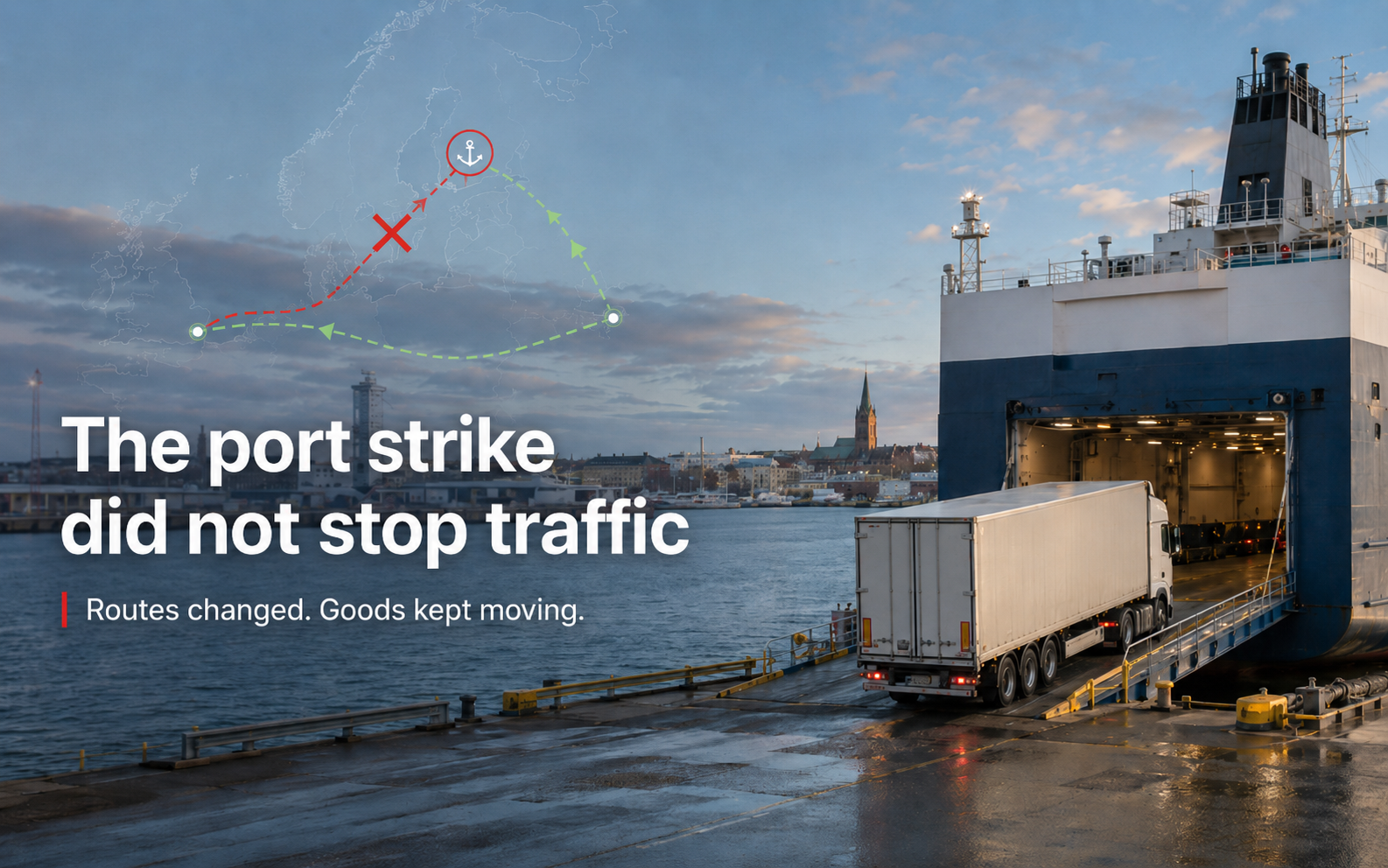
The stevedores’ strike was announced in bold headlines:
It will bring Finland’s ports and international traffic to a halt.
But did it?
No. At least not truck traffic. It did something much more interesting: it forced transport operators to find new routes.
From a logistics perspective, Finland is effectively an island. To get out of the country, goods need to travel by ship, whether in a container or on a truck.
Of course, you can also drive to Europe via Haparanda and Sweden, but in most cases it makes little commercial sense. It is cheaper and faster to drive onto a ferry and continue from there to Sweden, the Baltics, Central Europe or even the UK.
This was precisely the traffic that the stevedores’ strike was supposed to stop.
What does a stevedore actually do?
To understand the impact of the strike, you first need to know one thing:
Who drives the trailer onto the ship?
If both the tractor unit and the driver travel with the trailer, the answer is simple. The driver drives the entire combination onto the ship and off again at the destination port. But a large share of international trailer traffic works differently. In that case, only the trailer travels on the ship as an unaccompanied unit. The tractor unit and driver stay ashore.
The main reason is efficiency.
A trailer alone takes up around 14 lane metres on a ship. With the tractor unit, the whole combination requires around 17 metres. In addition, the driver needs a cabin or passenger accommodation, meals and other services – and above all, the driver spends hours sitting on the ship without actually performing transport work.
In unaccompanied trailer traffic, the same equipment can be used more efficiently.
The process can work like this:
A domestic haulier takes the trailer to the customer for loading and then delivers it fully loaded to the port. There, the trailer is uncoupled from the tractor unit and left waiting for shipment. A stevedore moves the trailer onto the ship with a terminal tractor and secures it.
At the destination port, a local stevedore pulls the trailer off the ship again and leaves it in the port area. After that, for example, a German haulier collects the trailer in Travemünde and delivers it to its final destination.
The driver changes.
The tractor unit changes.
But the same trailer keeps moving.
What happens if the stevedores stop working?
Unaccompanied trailer traffic stops.
But do the goods stop moving?
Not necessarily.
Business does not stop. It finds another route.
During a strike, the new route may be temporary. But if the disruption lasts long enough, the temporary solution can become the new normal. The port strike was a very concrete example of this.
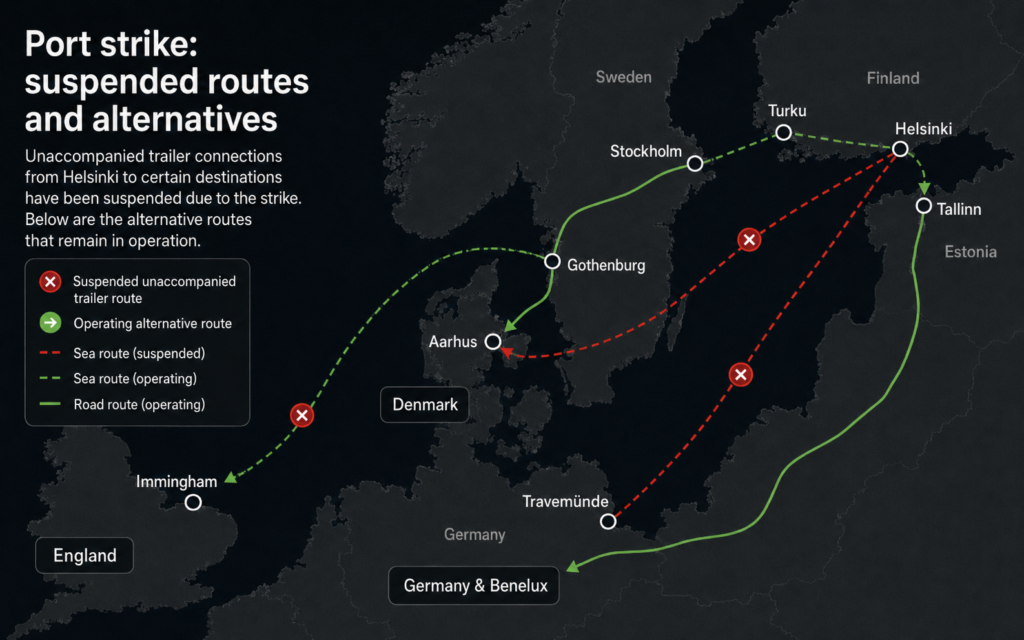
Germany – via Tallinn
One of the most important routes between Finland and Central Europe is Helsinki–Travemünde. A large share of the freight on this route moves as unaccompanied trailers. When stevedores stop working, this type of traffic quickly becomes difficult.
An alternative, however, can be found on the other side of the Gulf of Finland. A large share of traffic to Tallinn consists of accompanied combinations with both tractor units and drivers. The driver drives onto the ship personally, so Finnish stevedores are not required in the same way.
So freight began moving via Tallinn. From Finland by ferry to Estonia, then by road through the Baltics and Poland to Germany. The strike in Vuosaari therefore did not stop Finland–Germany traffic.
It simply shifted some of it onto another route.
Sweden and Denmark – the driver travels with the truck
Traffic to Sweden largely works on the same principle.
Passenger and ro-pax ferries depart from Helsinki, Turku and Naantali carrying accompanied truck combinations. The driver drives the vehicle onto the ship and off again at the destination port. That is why traffic to Sweden continued quite normally during the strike. And from Sweden, it is still possible to drive onwards to Denmark. If the direct unaccompanied trailer connection between Finland and Denmark is unavailable, the goods do not necessarily remain in Finland.
They simply take a longer road route:
Finland → Sweden → Denmark.
The route is slightly more expensive – especially when heading to Jutland – because the ferry between Finland and Sweden still has to be paid for, and there are more kilometres to drive.
But the goods keep moving.
What about the UK?
This is where things became more interesting.
Finnlines’ and Transfennica’s UK traffic was largely based on unaccompanied trailers. When the stevedores left the ports, these connections effectively stopped.
But UK freight did not stop.
It was still possible to drive to Sweden, and Sweden has functioning ferry connections to the UK. One viable route ran via Gothenburg to Immingham.
In practice, the solution was this:
UK export trailers were taken from Finland to Sweden with a driver. From Stockholm or Kapellskär, the journey continued by road to Gothenburg, where the trailers were transferred onto a ferry to the UK.
But simply taking an export trailer to Gothenburg would have been poor use of both the driver and the equipment. So the return traffic was arranged at the same time. A Finnish haulier took a UK export trailer to Gothenburg and collected a UK import trailer arriving on the same connection for the return journey.
This meant the driver did not have to wait at the port or return with an empty truck.
Export load off.
Import load on.
And back to Finland.
The strike stopped one operating model – not the entire logistics system
The port strike undoubtedly caused delays, additional costs and a great deal of extra work.
Routes became longer. More drivers were needed. More fuel was consumed.
Transport planners had to make decisions in a matter of days that under normal circumstances might have been planned for weeks. But traffic did not come to a halt in the way public discussion might have suggested. When one route closed, freight forwarding found another.
When an unaccompanied trailer could no longer move, a tractor unit and driver were added.
When a direct ferry connection disappeared, the route was diverted through Sweden or the Baltics.
This is one of those things that people outside logistics rarely see. In the finished delivery, all you ultimately see is that the goods arrived. Behind the scenes, however, someone may have rebuilt the entire transport chain during the previous 24 hours.
Logistics does not always go according to plan.
Its job is to keep moving even when the plan no longer works. That requires professional freight forwarders with the networks and systems to make it happen.