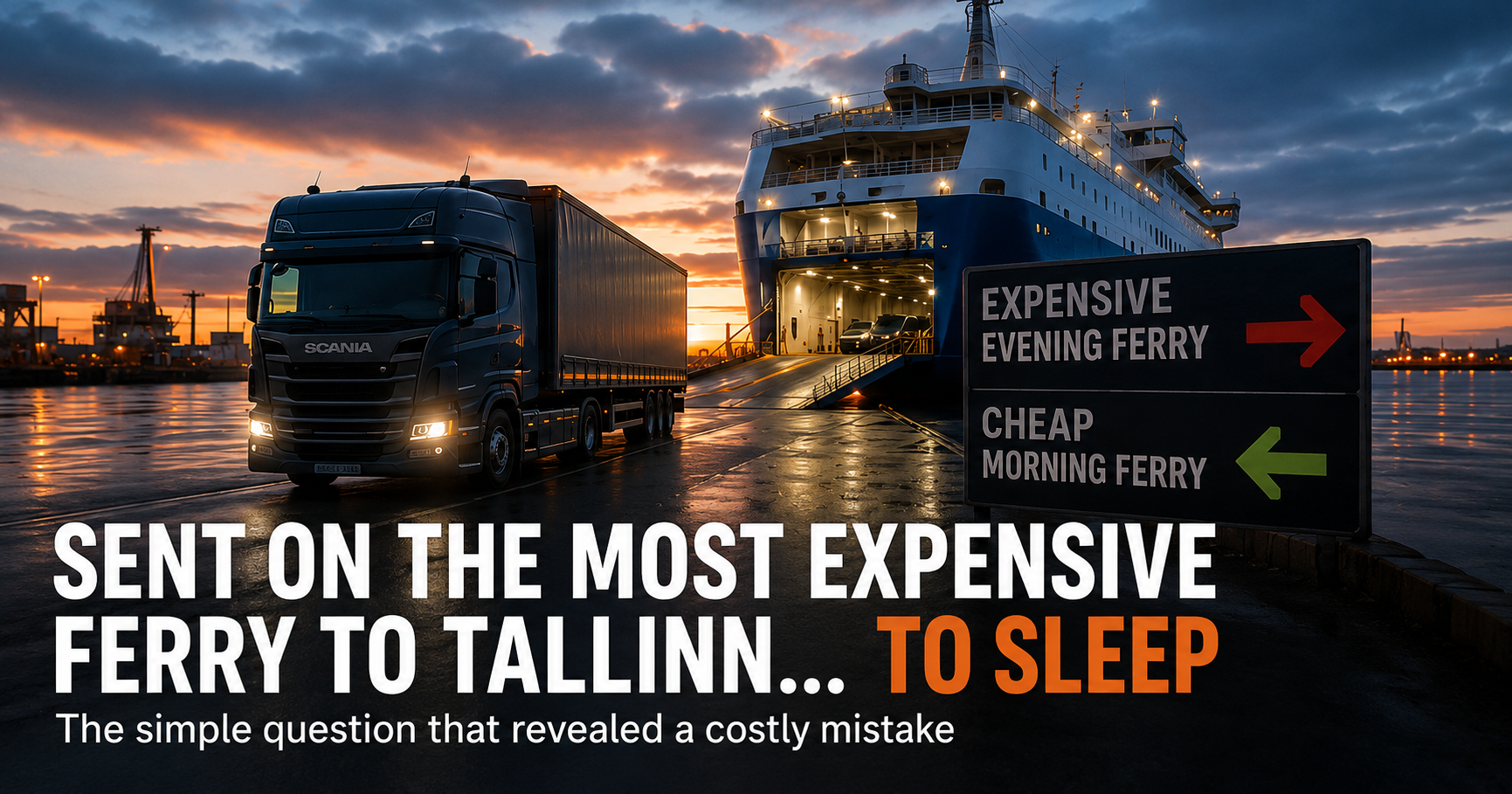
What happens next? – A simple question that reveals an incomplete view of the whole.
One of the fundamentals of leadership is seeing the bigger picture. That famous helicopter view, from which all the small stuff spinning around you begins to shrink and the essential becomes visible:
What is actually happening here?
One of the tools I use for this is a very simple question:
What happens next?
I often use it myself when designing operating models, processes and wider business solutions.
The question causes a surprising amount of confusion.
It forces you to shift your attention from the individual task at hand to the entire chain of events. To what happens after the decision has been made – and what happens after that.
Small pieces will always form some kind of whole. Whether they form a functioning whole, however, is usually determined only a couple of steps later.
Still a little too abstract?
No problem. Let’s make it practical.
Accompanied road freight via Tallinn
When I previously worked as Road Director for the Finnish subsidiary of an international freight forwarding company, I had the following discussion with one of my employees about our Eastern European road freight operation.
The traffic moved via Tallinn as accompanied units, rather than traditional unaccompanied trailer traffic.
In practice, the same driver and tractor unit remained attached to our trailer throughout the journey. A driver could leave Finland with a load bound for Poland, Slovenia or Italy, for example, and return to Finland with the same combination a couple of weeks later.
At the time, we made extensive use of the ferries between Helsinki’s West Harbour and Tallinn. Departures were frequent, and the afternoon and early-evening sailings from Helsinki were naturally the most popular.
The logic was easy to understand.
The driver arrived in Finland from Tallinn in the morning, delivered the inbound loads to customers and then began collecting and loading new outbound freight. Once the truck was ready in the afternoon, the aim was to get it back to Tallinn as quickly as possible and from there onwards towards Central or Southern Europe.
That is why the cheapest morning ferry could cost less than €200, while the most popular evening departures between 16:00 and 18:00 could cost €600–700 per truck.
This gave me an improvement idea, which I began testing with one of my employees.
– Why are you sending the driver out on the most expensive evening ferry?
– So that he can reach the mainland again on the same day.
– But why?
– Well… so that we get a faster schedule. We’ll reach somewhere like Poland sooner.
– Good idea. But what happens next? What happens after you have sent the driver to Tallinn?
– Well, he drives off the ferry and continues the journey…?
Except he doesn’t.
Driving time and working time are not the same thing
At this point, you need to understand the basic principles of drivers’ hours regulations.
Driving time and actual working time are two different things.
As a general rule, daily driving time is nine hours, and the required breaks must be taken during the driving day. Driving time is accumulated while the vehicle is moving.
A driver’s working day, however, does not consist solely of driving.
When the driver is loading at a dock, unloading at a customer, handling paperwork or waiting at a terminal, driving time may not be running – but working time is.
Drivers “working time” is not directly set in legislation, but mandatory 11h daily rest gives us even with short math – a daily working time of 13hours, and nothing more.
When the driver had arrived in Helsinki on the morning ferry from Tallinn and started the day at around 07:00, the working day was effectively over by the evening after completing the inbound deliveries and loading the outbound freight. Meaning: 20:00 you have to start your daily 11h rest.
Even though we had bought an expensive evening ferry ticket, the journey did not continue from Tallinn towards Poland.
The driver drove off the ferry and began the daily rest period.
– Okay. So the driver arrives in Tallinn, but in practice the journey goes no further than driving off the ferry, because he has to take his mandatory daily rest?
– Err… now that you mention it, I suppose that is exactly what happens.
– Exactly.
So now we have sent the driver to Tallinn on the most expensive ferry possible – just to sleep.
What if rushing actually slows the journey down?
What if, after loading, we sent the driver to Vuosaari instead?
The driver could take the daily rest period there in peace. Vuosaari has spacious truck parking areas and practically all the services a driver needs during a break, including shops and refuelling facilities.
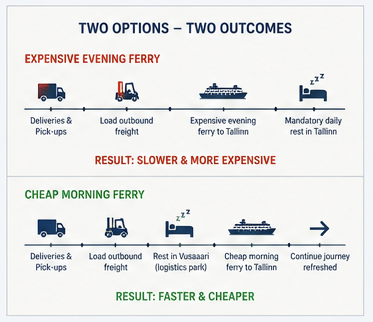
The following morning, the driver would take an inexpensive morning ferry to Tallinn.
At first glance, the outcome seemed slightly counterintuitive:
- the driver was able to begin the daily rest period earlier
- there was no unnecessary rush during the day’s loading operations
- the ferry ticket cost considerably less
- the driver was rested and ready to continue immediately after arriving in Tallinn
- the truck could reach its final destination even earlier than the one sent on the expensive evening ferry
The driver we had rushed to Tallinn the previous evening might still have had one or two hours of mandatory daily rest remaining the following morning.
The driver arriving on the morning ferry, by contrast, could continue directly from the port towards Poland.
The expensive option looked fast, but it was slow.
The cheap option looked slow, but it was fast.
What did this mean in euros?
Let’s take a simple example.
If a freight forwarding company has 20 weekly crossings from Helsinki to Tallinn and ten of them can be moved from the expensive evening departure to the inexpensive morning ferry:
€700 − €200 = €500 saved on one crossing
10 trucks per week = €5,000 saved per week
Over four weeks = approximately €20,000 saved per month
And the service did not become slower.
In the best-case scenario, it became faster.
What happens next?
This is what I mean by the “What happens next?”
way of thinking. An individual decision can look perfectly sensible when viewed only from the exact point at which it is made.
The expensive evening ferry looks fast.
Rushing looks efficient.
An early departure looks like good customer service.
But when the chain of events is examined a couple of steps further ahead, the meaning can be turned completely upside down.
In this case, rushing did not get the shipment to its destination any faster.
It sent the driver to Tallinn to sleep – at an extra cost of €500.